
 Photo by Jatin Shah / MagiK Box
Spot-Lot Builders in Port St. Lucie
Entry detail on a completed Port St. Lucie spot-lot build. Column work, the paver walk and the stucco finish are where the difference between builders shows up.
Once you have a lot in Port St. Lucie, or you are close to one, the question becomes who puts a house on it.
This is part two of three on building in Port St. Lucie. Part one covers choosing the lot, which is the decision that matters most and the one to make first. This part covers who actually builds on scattered lots here, how to tell a good one from a thin one, and how to approach a sales office without losing your own representation. Part three covers the money and the timeline.
Two Different Kinds of Builder
Before anything else, work out which conversation you are actually in — because "new construction" in this city means two quite different businesses.
There are community builders. You buy a homesite inside their development, they control the land, the utilities, the road and the sequencing, and you choose from a defined set of plans. Price is more predictable because they have built that plan on that street forty times. There is usually an association, often a CDD, and generally amenities attached.
Then there are spot-lot builders. They put a house on an individual platted lot — one you already own, or one they will sell you. Every job is a one-off: different soil, different setbacks, different utility situation, different neighbours. Usually no association, usually no amenities, and considerably more variables between the contract and the keys.
Some firms do both, and market it that way — a couple of the builders below will sell you a homesite in their community or build on yours, and the terms are not the same in each case. Ask which one you are being quoted.
Neither model is better. They suit different people. If you want predictability, amenities and a finished street on day one, the community route is genuinely the easier path. If you want a specific location, a bigger parcel, no monthly association obligation, or somewhere to put a boat, the spot-lot route is the one that gets you there — and this page is about that route.
The Builders
There are, by one industry count, more than forty builders offering some form of build-on-your-lot programme in the Port St. Lucie area, spanning roughly $276,000 to well over three million. That is a directory, not a shortlist, and a directory is not much use to anyone.
They also do not all have the same reputation, and it would be dishonest to pretend otherwise. What follows is a starting point, not a ranking — check each one yourself. Talk to owners of their completed homes, look them up with the Treasure Coast Builders Association and the Better Business Bureau, and search the county's permit and complaint records for the company name. Reputations here are earned locally and they change.
These are the ones worth starting with. I have sat down inside four of these sales offices myself — Homecrete, Holiday Builders, Maronda and Adams — gone through the plans and asked the questions further down this page. RJM is here for what it advertises and builds rather than a visit of my own. Treat the list as a starting point rather than a recommendation, and put those same questions to whichever ones you visit.
Homecrete Homes
A local Treasure Coast builder headquartered in the area, and the one whose model is most explicitly built around scattered lots — they market a scattered-lot custom product directly. Twice named Builder of the Year by the Treasure Coast Builders Association.
Holiday Builders
A large Florida builder whose Cornerstone Collection is specifically structured for building on a buyer's own lot, with a defined set of plans and selectable upgrades.
Maronda Homes
Markets build-on-your-homesite alongside its own communities, with a meaningful share of no-HOA single-family product in Port St. Lucie — which matters, because much of the spot-lot grid sits outside any association.
RJM Homes
Advertises a build-on-your-lot programme covering Port St. Lucie and the wider Treasure Coast, at the more custom end of the range.
Adams Homes
Long-established in Port St. Lucie with an extensive presence across the city.
This shortlist is current as of August 2026. Builder rosters and price bands in Port St. Lucie change quickly — if you are reading this much later, ask us what has changed.
Two honest caveats. First, builder programmes change — plans get retired, price bands move, and a builder that takes scattered lots this year may stop next year. Confirm the current programme directly. Second, this is a starting shortlist rather than a ranking, and it is not the only good answer; there are capable builders working here who are not on it.
For the record: we have no arrangement of any kind with any builder on this page. Nobody paid to be listed, nobody is paying us for referrals, and we receive nothing extra if you build with one of them rather than another. They are here because I have been in their offices and these are the names I would give a friend.
Bring Your Agent to the First Appointment
This is the most expensive mistake buyers make with builders, and it costs nothing to avoid.
The person who greets you in a builder's sales office works for the builder. They are pleasant, they are knowledgeable, and they are not representing you. Their job is to sell that builder's houses at that builder's terms.
Most builders operate a registration policy: your agent has to be with you, or registered on your behalf, at your first visit. Tour alone on a Saturday afternoon, decide you like it, and come back later with an agent, and many builders simply will not recognise that agent on the transaction. You do not get a discount for having walked in alone — the price is the price. You just go through the process without anyone on your side of the table.
There is also a paperwork step now. To represent you I need a signed buyer broker agreement in place before we tour, which is the standard across the industry since the 2024 changes. So the sequence that actually works is straightforward: sign the agreement, then I come with you to the first appointment. After that you can go back on your own as often as you like.
None of that costs you anything at the sales office. It just determines whether you have representation when the contract, the allowances, the escalation clause and the warranty terms come up — which, on a build, is exactly when you want it.
What Separates a Good Spot-Lot Builder From a Thin One
Spot-lot work is harder than building in a subdivision. In a community the builder controls the site, the utilities and the sequencing. On your lot, none of that is true — every parcel is a one-off.
The questions that surface the difference:
- How many homes have you built on scattered lots in Port St. Lucie specifically, in the last two years?
- Does your quoted price include site work, or is that an allowance? What happens if the allowance is exceeded?
- Who pulls the permits, and who carries the risk if plan review takes longer than expected?
- What is the price-escalation clause, and is there a cap?
- What is fixed in the contract and what is an allowance? Ask for the allowance schedule in writing.
- What is the warranty, who honours it, and how are claims handled after closing?
- Can I see three homes you completed on scattered lots in this city, and speak to those owners?
That last one does more work than the other six combined. A builder genuinely doing this volume will hand the references over without hesitating.
Spec Homes: The Third Option, and Often the Right One
Every builder on that list carries spec inventory, and a lot of buyers should be looking at it before they look at anything else.
A spec home is one the builder starts without a buyer under contract — on their own lot, to their own plan, with their own finish selections. Some sell before completion, some stand finished for a while. Either way you are buying a new house rather than commissioning one.
The case for it is strong, and it is essentially the case for new construction with the hard parts removed:
- No construction loan. You buy it with an ordinary mortgage, which is simpler, cheaper and available from far more lenders.
- No construction timeline risk. You are looking at a house with a completion date you can see, or one already standing.
- No site-work surprises. The fill, the drainage, the utility connection and the permit queue have already happened, at the builder's risk rather than yours.
- Everything is still new. New roof, new air conditioning, new appliances, current building code and current wind provisions — which is the entire reason we search 2020 and newer to begin with.
The trade is control. You take the builder's lot, the builder's plan and the builder's finish choices. If the spec is caught early enough you can sometimes still pick flooring, cabinets and paint; once it is finished, what is there is what you get.
Two things to watch, and they are the same two from earlier on this page.
The first is the lot, again. A spec sits on land the builder chose from their own inventory, which loops straight back to the warning above — look at that parcel as hard as you would look at one you were buying on the open market.
The second is how long it has been standing. Builders carry real cost on unsold spec inventory, so a house that has been finished for a while can come with genuine motivation attached, particularly near the end of a quarter or a year. That can be an opportunity. It can also be a signal — sometimes a spec sits because of the lot, the layout or the price, and it is worth working out which before you decide you have found a bargain.
Ask how long it has been complete, what it was originally listed at, and whether the price has moved. The answers tell you which situation you are in.
The Bottom Line
The builder matters less than the lot, but it still matters. What separates a good spot-lot builder from a thin one is almost never the model photos. It is whether they will give you completed addresses to drive past, whether the allowances are real numbers, whether the contract handles cost escalation, and whether anyone answers the phone eleven months after closing.
Ask for three finished scattered-lot homes in Port St. Lucie and the owners' details. A builder who is happy to hand those over is telling you something. So is one who is not.
What all of it costs, and how the financing actually works, is part three.
Community Guide
Neighborhoods, schools, prices, and lifestyle — all in one place.
Port Saint Lucie Market Trends
Live data from the local MLS.
Thinking about Port St. Lucie?
We're local experts — let's find the right home for your move.
Homes for Sale in Port St. Lucie
Single-family homes $500k+, updated daily.
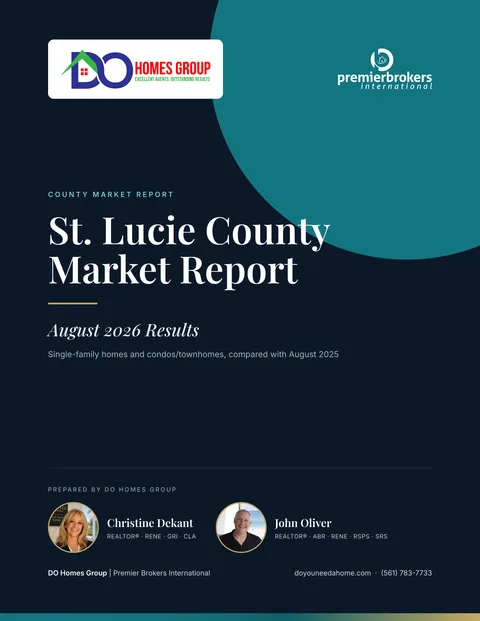
Free — August 2026 St. Lucie County Numbers
Houses Are Tight Here. Condo Buyers Still Have Choice.
In August 2026, houses sold at 95.5% of asking in 54 days, so there was less room than most buyers expect. Condos ran 7.6 months of supply and 82 days, which is a different negotiation entirely. Both sets of numbers, in one free PDF.
Free instant PDF · No obligation · See what's inside →
Frequently Asked Questions
Which builders build on your own lot in Port St. Lucie?
More than forty builders offer some form of build-on-your-lot programme in the area. A reasonable starting shortlist includes Homecrete Homes, Holiday Builders, Maronda Homes, RJM Homes and Adams Homes. Programmes change, so confirm the current offering directly with the builder — and ask any of them for three completed scattered-lot homes in Port St. Lucie and the owners' contact details.
Do I need my agent with me at the builder's sales office?
Yes, at the first visit. The person in the sales office works for the builder, not for you. Most builders operate a registration policy requiring your agent to be present or registered on that first visit, and if you tour alone many will not recognise your agent on the transaction afterward. You get no discount for going in alone — the price is the price — you simply go through it without representation.
What is the difference between a production builder and a custom builder on a spot lot?
A production or semi-custom builder puts one of their existing plans on your parcel, which is faster, cheaper and less flexible. A custom builder designs to the parcel and to you, which costs more and takes longer. Both are legitimate; they suit different buyers and different lots.
How do I tell a good spot-lot builder from a thin one?
Ask for three completed scattered-lot homes in Port St. Lucie with owner contact details. Ask whether allowances are real numbers or placeholders, how the contract handles cost escalation, who pulls and closes out the permits, what the warranty covers and for how long, and who answers the phone a year after closing. The model home tells you very little.
Keep Reading
This article is provided by DO Homes Group at Premier Brokers International for informational purposes only and does not constitute legal, financial, tax, or investment advice. Market statistics, pricing, availability, HOA fees, and community details change frequently and may have changed since publication. School assignments, boundaries, and ratings may change — verify all school information directly with the appropriate school district, and consult official public safety resources for any crime data relevant to your search. Verify all details independently and consult the appropriate licensed professionals before making any real estate decision. DO Homes Group is committed to Equal Housing Opportunity and does not discriminate on the basis of race, color, religion, sex, handicap, familial status, or national origin.