
Free 2026 Edition · Instant PDF Download
Florida Condo Buyer’s Due-Diligence and Red-Flag Checklist
In Florida, the association is half the purchase. This is the checklist we walk our own condo buyers through — the documents to request, what to look for in each, and the questions to ask while you can still walk away.
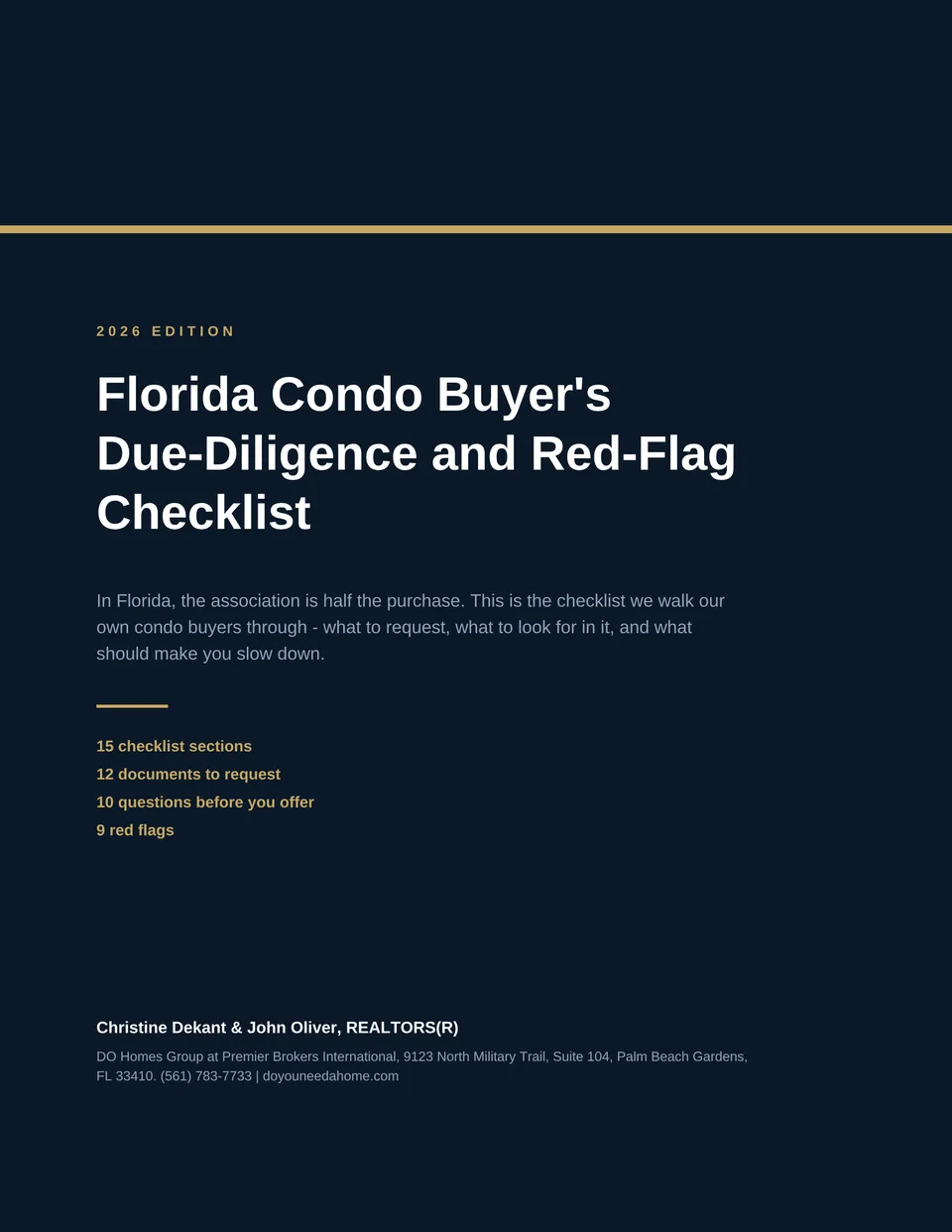
15
Checklist Sections
12
Documents to Request
10
Questions Before You Offer
9
Red Flags to Watch
Free Condo Buyer’s Checklist
Download the 2026 Edition now
The PDF downloads immediately after you submit — no waiting on an email.
The Short Version
Why the Building Matters More Than the Unit
Two identical units on the same street can be very different purchases. One sits in a building with funded reserves, a completed structural inspection and stable dues. The other sits in a building carrying a loan, an inspection it has not scheduled, and a board discussing an assessment in minutes nobody sent you. The unit tour tells you nothing about which is which — the association’s paperwork does. This checklist is the sequence we use with our own condo buyers: what to request, what to look for in it, what to ask before making an offer, and what should make you slow down.
What's Inside
- The association’s financial statements, reserve schedule and meeting minutes tell you more about your future cost than the unit does.
- Reserves that are waived or minimally funded do not remove a cost — they move it into your future as an assessment.
- Tell your lender the building name before you write the offer. In a condo purchase the building has to qualify too.
- Ask about assessments twice: one already levied, and one being discussed but not yet voted.
- Rental and pet rules, buyer approval, and one-time transfer costs are the most common post-closing surprises, and all are verifiable in advance.
- Every item here is a question for the association’s own documents and your own professionals — not a substitute for them.
Made for Both Sides of the Decision
If You Are Buying
- Work through the list in order and you will know more about the building than most owners in it.
- Ask the financing question first — it is the most common avoidable reason a condo deal falls apart.
- Use the review period deliberately: request everything in writing and date-stamp what you received.
If You Are Selling a Condo
- Every item a buyer will ask for is an item you can have ready before you list.
- Buildings with clean, complete, quickly produced paperwork are trading differently from buildings without it.
- Knowing your association’s weak spot in advance lets you price and position for it instead of discovering it in escrow.
Download immediately after completing the form · No obligation
Association Financial Documents
The building's finances tell you more about your future cost of ownership than the unit ever will. Ask for these in writing, and read them before you are emotionally committed to the unit.
The last two to three years of financial statements
You are looking for the direction of travel, not a single snapshot. Are operating costs rising faster than dues? Is the association ending each year even, ahead, or short?
The most recent audit or review, if one exists
Ask whether the association's financials are audited, reviewed, or compiled, and by whom. Ask why, if the answer is none of the three.
Accounts receivable and delinquency levels
Ask what share of owners are behind on dues. Widespread delinquency shifts costs onto the owners who do pay, and it can affect a building's financing eligibility.
Any loans the association is carrying
Associations can borrow. Ask whether there is an outstanding loan, what it funded, what the payments are, and how long it runs.
Budgets and Reserves
Reserves are the money set aside for the expensive things that wear out on a schedule: roof, elevators, paving, painting, plumbing risers. Underfunded reserves do not make a cost disappear - they move it into your future as an assessment.
The current year's budget, line by line
Compare it against last year's actual spending. Ask about any line that moved sharply in either direction.
The reserve schedule and the current reserve balance
Ask what components are on the reserve schedule, what remaining useful life the association is assuming for each, and how much is actually in the account today.
Whether reserves are fully funded, partially funded, or waived
Ask directly, and ask how the answer has changed over the last several years. Ask what the association's plan is for any gap.
The last few years of dues increases
A building that has held dues flat while costs rose is usually deferring something. Find out what.
Any reserve study or structural reserve analysis on file
If one exists, ask for it in full, not for a summary. If one does not exist, ask why not and whether one is planned.
Structural and Milestone Inspection Documentation
Florida buildings of a certain age and height are subject to inspection requirements, and the results drive both cost and financing. Requirements vary by building, age, county and municipality - confirm what applies to your specific building with the association and your attorney rather than assuming.
Any completed milestone or structural inspection report
Ask for the full report and any follow-up engineering reports, not the cover letter.
The status of any required repairs identified
Ask what was found, what has been repaired, what is scheduled, what is unfunded, and who is doing the work.
When the next inspection is due
An inspection that is coming up shortly after your closing is a cost event you want to know about before you write the offer, not after.
Concrete restoration, balcony, and waterproofing history
Coastal buildings live with salt air. Ask when the building was last restored and painted, and what the association expects next.
Roof age and elevator modernization history
Both are large, predictable, expensive items. Ask when each was last done and what the reserve schedule assumes.
Special Assessments
A special assessment is a bill sent to owners on top of regular dues. Assessments already levied, and assessments being discussed, are two different risks - ask about both.
Any assessment currently levied or being collected
Ask the amount, the payment schedule, the remaining balance, and - critically - who is responsible for the unpaid portion after closing. That is a negotiable contract term, not a fixed rule.
Any assessment under discussion but not yet voted
Board meeting minutes are where these surface first. Ask for the last twelve months of minutes.
The assessment history of the last five to ten years
A pattern of repeated assessments tells you the reserves are not carrying the building.
How the association has historically funded large projects
Reserves, a loan, or an assessment. The answer tells you what to expect the next time something large comes due.
The Full Checklist
All 15 Sections
The four sections above are reproduced in full. The PDF contains all 15, formatted so you can work through them in order and check items off as the documents arrive.
01
Association Financial Documents
4 items
02
Budgets and Reserves
5 items
03
Structural and Milestone Inspection Documentation
5 items
04
Special Assessments
4 items
05
Association Insurance
5 items
06
Your Own Insurance
4 items
07
Financing and Building Eligibility
5 items
08
Pending Litigation
4 items
09
Rental Restrictions
6 items
10
Pet Restrictions
4 items
11
Application and Approval Requirements
6 items
12
Capital Contributions and Transfer Fees
5 items
13
Maintenance Responsibilities
6 items
14
Questions to Ask Before You Make an Offer
10 items
15
Documents to Review During Your Contractual Review Period
12 items
Slow Down If You See These
9 Red Flags
None of these means walk away on its own. All of them mean ask another question, and get the answer in writing, before your inspection period runs out.
- Reserves that are waived or minimally funded in a building with an aging roof, elevators, or concrete.
- Dues that have been held flat for years while insurance and labor costs rose.
- A pattern of repeated special assessments rather than reserve-funded projects.
- Meeting minutes that discuss a project with no identified funding source.
- A milestone or structural inspection that has not been completed, or repairs identified with no schedule.
- High owner delinquency, or a small number of owners holding a large share of the units.
- Litigation the association will describe only verbally.
- A lender who cannot confirm the building's eligibility, or who declines to review it.
- Documents that arrive slowly, incomplete, or only after repeated requests.

Christine Dekant
REALTOR® · RENE · GRI · CLA · CPRES

John Oliver
REALTOR® · ABR · RENE · RSPS · SRS
Prepared by
About Christine & John
Christine Dekant and John Oliver lead DO Homes Group at Premier Brokers International in Palm Beach Gardens, serving buyers and sellers across Palm Beach County and the Treasure Coast. They live in the communities they serve, they answer their own phones, and every guide and report on this site is built from the same information they use to price listings and advise their own clients.
Frequently Asked Questions
What does the condo due-diligence checklist cover?
Association financial documents, budgets and reserves, structural and milestone inspection documentation, special assessments, association insurance, your own unit-owner insurance considerations, financing and building eligibility, pending litigation, rental restrictions, pet restrictions, application and approval requirements, capital contributions and transfer fees, maintenance responsibilities, the questions to ask before making an offer, and the documents to review during your contractual review period.
Is this legal advice?
No. It is general information for buyers — a list of documents to request and questions to ask. It is not legal, financial, tax, insurance, engineering or inspection advice, and it does not replace a Florida real estate attorney, your lender, a licensed insurance agent, or a licensed inspector. Requirements differ by building, age, county and municipality, and they change.
When should I use it?
Start before you make an offer — the financing question and the dues, assessment and rule questions can all be asked while you are still shopping. Then use the document list during your contractual review period, and give your attorney time to actually read what arrives.
Does it apply outside Palm Beach County?
The document and question list applies to Florida condominium purchases generally. Specific inspection, disclosure and approval requirements vary by building and by local jurisdiction, so confirm what applies to your building with the association and your attorney.
Is the checklist really free?
Yes. Enter your name and email and the PDF downloads immediately — no payment, no obligation, and your information is never shared or sold.
Keep Exploring
More From DO Homes Group
This checklist is general information for buyers, not advice. It is not legal, financial, tax, insurance, engineering or inspection advice, and it does not create a professional relationship of any kind. Condominium requirements differ by building, by age, by county and by municipality, and they change. Every item here should be verified for your specific building with the association's own documents and reviewed by the appropriate licensed professionals - a Florida real estate attorney, your lender, a licensed insurance agent, and a licensed inspector or engineer - before you rely on it. DO Homes Group and Premier Brokers International make no representation about any particular building or association.