
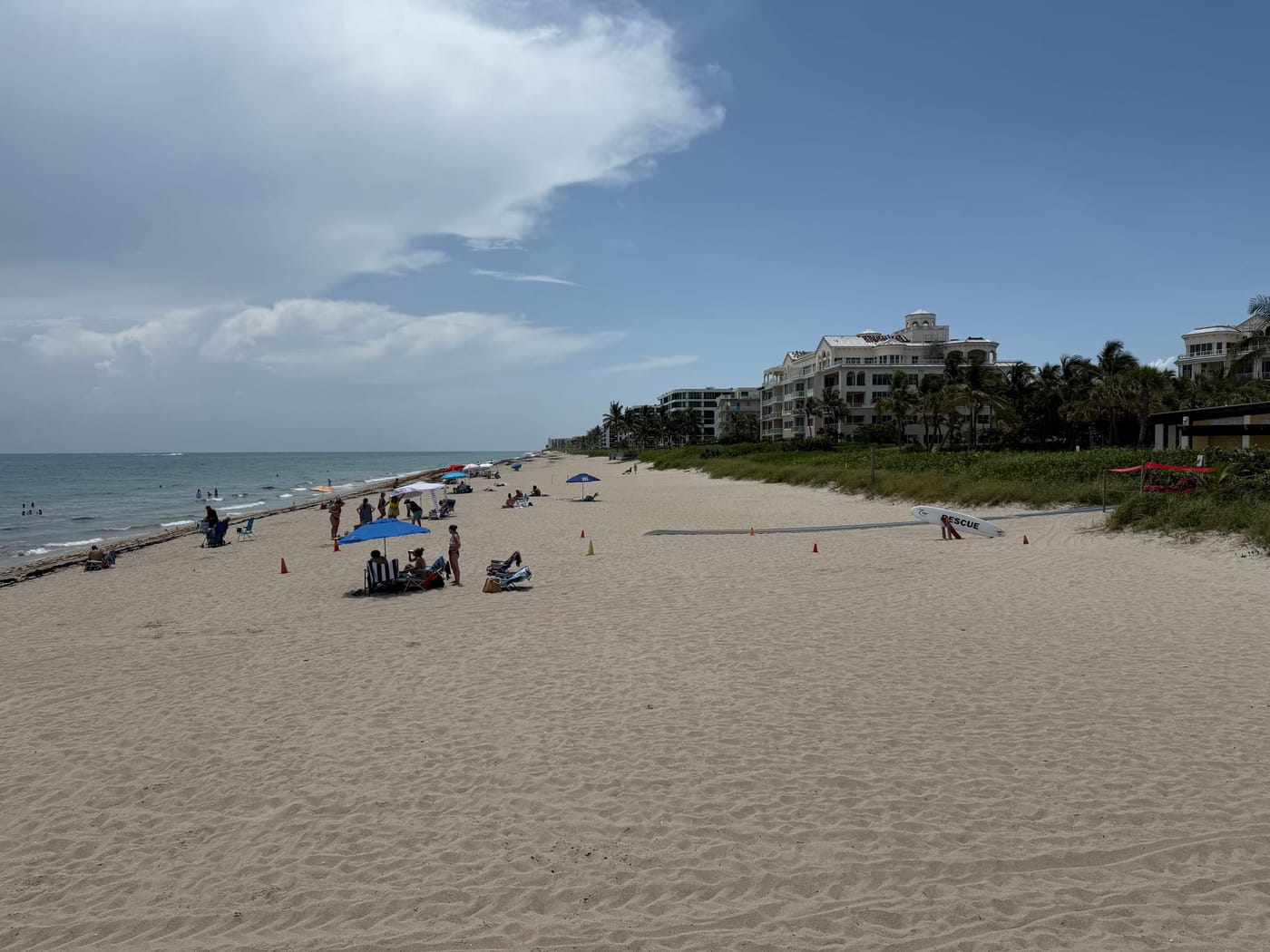
 Photo by John Oliver
What It's Really Like Living in Lake Worth Beach, Florida
Living in Lake Worth Beach, Florida means living in one of Palm Beach County's older coastal cities: a townsite first platted in 1912, a downtown along Lake and Lucerne Avenues, six local historic districts, a City-run beach and pier across the Intracoastal, and a utility the City owns. It's a lived-in place rather than a polished one, and those facts shape daily life more than any reputation does.
This guide is for deciding whether to live here. It covers where the city actually is, what an ordinary week looks like, what owning an older house involves, the real compromises, and a checklist for the address you're considering.
First: which "Lake Worth" is it?
The city was incorporated as Lake Worth in 1913. In March 2019 its voters approved renaming it Lake Worth Beach. The "Lake Worth" mailing address didn't shrink to match. It still covers a much larger area to the west, much of it unincorporated Palm Beach County.
This matters in three ways:
- Location and lifestyle. A listing that says "Lake Worth" may be several miles inland, in a suburban area with no connection to the downtown or the beach described here.
- Taxes and services. Local government, property-tax millage, permitting, code enforcement and emergency services follow the exact parcel, not the mailing address.
- Search results. A home search for "Lake Worth" usually mixes city and county addresses together. Filter by the municipality on the listing, or check each property yourself.
Two things that don't settle the question:
- The utility bill. The City's electric utility also serves customers outside city limits, including parts of the Village of Palm Springs and unincorporated Palm Beach County, according to a 2025 Moody's rating summary published by the Florida Municipal Electric Association.
- The ZIP code. Check the parcel with the Palm Beach County Property Appraiser and the county's municipal boundary maps.
In this guide, "Lake Worth Beach" means the incorporated city only.
An old city, built on a 1910s plan
According to the City's historic preservation pages, the Palm Beach Farms Company named the new townsite "Lucerne" in 1912, and it was incorporated as Lake Worth in 1913 after a conflict over the postal name. The City dates the start of development in its Old Lucerne district to after that 1912 platting.
The City lists six local historic districts: College Park, Old Lucerne, Old Town (the commercial district), Northeast Lucerne, Southeast Lucerne and South Palm Park. Its district summaries cite periods of significance running from 1915 through 1952, and put College Park's main growth in 1925–1928 and 1945–1949.
So much of the housing close to downtown dates from the first half of the twentieth century, and it looks and behaves like it. Our neighborhood guide goes area by area.
Daily life downtown: Lake and Lucerne Avenues
Downtown is Lake Avenue and Lucerne Avenue, the city's main east–west streets. The City's Old Town commercial historic district sits between the Northeast and Southeast Lucerne neighborhoods, so homes and the main commercial blocks are close together.
What that means day to day:
- Walking. From a house a few blocks away, the walk to shops, restaurants and events is short. From the western parts of the city, most errands are a drive.
- Arts and culture. The Cultural Council for Palm Beach County, the county's arts agency, has its headquarters and gallery at 601 Lake Avenue. It's closed for renovation until October 6, 2026, with new exhibitions from October 16, so check its hours before you go.
- Independent businesses. Much of downtown is small storefronts in older buildings. Expect a lived-in streetscape rather than a uniform, newly built one, and judge the specific blocks you'd use.
- Parking. The City's Parking Division, at 809 Lucerne Avenue, handles rates, permits and citations. There are pay-to-park lots and a downtown garage (the City's festival page names the Bohemian Parking Garage). If a house has no off-street parking, see how the block's street parking works on a weekend night.
Free Relocation Decision Guide
Palm Beach County or the Treasure Coast?
A side-by-side comparison of 14 areas we actually work in — from Boca Raton to Port St. Lucie — across 12 things that decide where you should live.
Getting to the beach: the bridge and the barrier island
The city's mainland and its beach are separated by the Lake Worth Lagoon, which the Intracoastal Waterway runs through. Lake Avenue, which is State Road 802, crosses it on a bascule drawbridge that opens for boat traffic, and the road ends at A1A on the barrier island.
Two practical consequences:
- The beach is a short trip, not a stroll, from most of the mainland. Drive it, bike it or walk it from the specific address before you count on "near the beach."
- The bridge is the direct route. Openings add time, and repairs can too. In March 2025, a mechanical failure closed half of the bridge's lanes for weeks while FDOT fabricated and installed a replacement part, according to WPTV.
On the island, the City runs its beach complex:
- The Casino Building. The rebuilt Lake Worth Beach Casino Building and Beach Complex opened on March 1, 2013. The City says the new building stays true to the original 1920s architecture. Shops and restaurants are on the ground floor, and a ballroom on the second floor is rented for events.
- The William O. Lockhart Municipal Pier, extending into the Atlantic from the beach complex.
- Lifeguards and parking. The City has an Ocean Rescue team, and residents can apply online for annual or seasonal beach parking permits. Check current rates, eligibility and designated spaces with the City.
Official resources: City of Lake Worth Beach — Beach and Pier · City Parking Division
The lagoon side: Bryant Park and Snook Islands
At the mainland end of the bridge, the City's Bryant Park sits on the Intracoastal at Lake Avenue and Golfview. The City lists a boat ramp with four launching pads and boat-trailer parking, a band shell with a stage, a fishing pier, and a one-mile Heart Trail. Trailer launches need a City boat ramp parking permit.
Next to it is Palm Beach County's Snook Islands Natural Area, at 100 North Golfview Road: a lagoon restoration project with mangrove islands and oyster reefs, a boardwalk, a kayak launch and a fishing pier. It's open sunrise to sunset, with additional parking and restrooms in Bryant Park.
Official resources: Bryant Park · Snook Islands Natural Area
Events and the rhythm of the year
The Lake Worth Beach Street Painting Festival is an annual, City-organized, free event in February. Artists work in chalk on Lake and Lucerne Avenues between Dixie and Federal Highways. The 2026 edition, the 32nd, ran February 21–22. For that weekend, the City closed Lake and Lucerne Avenues and parts of J, K, L and M Streets to vehicles from early Friday morning through Sunday night. If you live on or near those blocks, access and parking change for the weekend.
In our experience, winter and spring are the busiest time for events, restaurants and traffic across Palm Beach County, and summer is hotter, wetter and quieter. The Atlantic hurricane season runs June 1 through November 30, which matters for insurance, storm preparation and older windows and roofs.
Official resources: Street Painting Festival — information and FAQ
Buying a home here: what an older house involves
This is where most of the decision sits. A house with character and a house that's inexpensive to own aren't the same thing, and here the two often come apart.
Historic districts and design review. Inside the six districts, the City's Certificate of Appropriateness process applies to exterior alterations such as roofs, windows and doors, and to additions, new construction, demolition and relocation, alongside the building permit. Replacing windows or a roof, or adding a room, can take more planning than it would elsewhere. Confirm a property's district status before you budget a renovation around it.
The age of the systems. In a decades-old house, the purchase price is only the start. Ask for:
- The age of the roof, and whether windows and doors are impact-rated or shuttered.
- The condition of the electrical panel and wiring, the plumbing supply and drain lines, and the sewer lateral.
- The City's permit history for past work, so you can tell permitted updates from unpermitted ones.
- A full inspection, plus a quote from your insurance agent on which inspections they'll require (four-point and wind-mitigation reports are common requests for older Florida homes).
Flood and insurance. Look up the flood zone on FEMA's Flood Map Service Center, and get a property-specific insurance quote during your inspection period rather than after it. Roof age, openings and construction year can change both availability and price.
Lots and parking. Older parcels vary widely. Check the survey for lot size and setbacks, whether there's a driveway or off-street space, and what zoning allows before you plan an addition, pool, garage or accessory unit.
New construction. If you want a new house, confirm what's actually available. Much of the housing near downtown dates from the historic periods above, so newer homes are more often infill projects or renovations than whole new neighborhoods.
Utilities. Lake Worth Beach runs its own electric utility, which it describes as nonprofit and citizen-owned, along with water service. Ask the seller for a recent year of bills, and read the City's current rate schedules rather than relying on anyone's generalization.
Official resources: City of Lake Worth Beach Utilities · Palm Beach County Property Appraiser
Getting around, and schools
Tri-Rail's Lake Worth Beach Station is at 1703 Lake Worth Road. Tri-Rail lists registered parking there at no charge for up to 12 hours a day, with Palm Tran routes 61 and 62 connecting. How long any trip takes by car depends on the address, the time of day and the season, so run your actual commute before you commit.
Public schools are assigned by address through the School District of Palm Beach County, and boundaries can change. Check the specific address with the district's Find My School tool rather than relying on a listing.
Official resources: Tri-Rail — Lake Worth Beach Station
The real compromises
- Older housing. Charm comes with maintenance, inspections and insurance questions a newer house wouldn't raise.
- Rules on the outside of the house. In a historic district, exterior changes go through review.
- Lots and parking. Off-street parking varies from house to house, and street parking can tighten near downtown and on event weekends.
- Uneven from block to block. Upkeep, traffic, noise, parking and the mix of homes and businesses can change within a few blocks. Visit the specific street on a weekday, on a weekend and after dark.
- Limited new construction. Buyers who want a new house with a warranty will find fewer choices here than in newer suburbs.
- Coastal weather. Flood zones, wind exposure and insurance cost need property-specific answers.
- Development and affordability. Growth is an open question here. The City requires affordable or workforce units in projects that receive density, intensity or height bonuses. Florida's 2023 Live Local Act lets qualifying multifamily and mixed-use projects in commercial, industrial or mixed-use zones be approved administratively if 40% of units are income-restricted for at least 30 years. And the Lake Worth Beach Community Redevelopment Agency (CRA) runs an Attainable Housing Project, backed by federal funding announced in March 2026, to reduce homeownership costs for households earning under 120% of the area median income. Check current applications near any address you're considering.
Official resources: Affordable/workforce housing program · Live Local in Lake Worth Beach · Lake Worth Beach CRA
Best fit, and potential mismatch
Lake Worth Beach tends to suit buyers whose priorities look like this:
- An older house matters to you, and you're prepared to budget time and money for it.
- You want to walk downtown, and you'll choose the block with that in mind.
- The water is part of the plan, whether that's the City beach, the pier, the lagoon or the boat ramp, and a short drive or ride to reach it is fine.
- You're comfortable with a place still changing, and you'd rather follow local planning than assume it's settled.
It may be a mismatch if:
- You want new construction, low maintenance and a builder's warranty.
- You want a beach you can walk to from the mainland, every day.
- You want uniform streets and HOA-maintained common areas throughout.
- You'd rather not deal with design review on exterior changes.
None of that is a verdict on the city. It's about matching the housing and the daily routine to what you want.
A quick decision framework
- Tour Lake Worth Beach first if at least two of the best-fit points describe you and the budget has room for older-home costs.
- Compare it with neighboring cities if you're split. Our comparison with nearby cities sets out the differences, and the pros and cons of living in Lake Worth Beach weighs the trade-offs point by point.
- Focus on a different area if new construction, a walk-to-the-sand beach or a uniform HOA community is non-negotiable.
Buyer due-diligence checklist
- Jurisdiction: City of Lake Worth Beach or unincorporated Palm Beach County, confirmed on the parcel record.
- Historic district status, and what a Certificate of Appropriateness would require for your plans.
- Inspections: a full inspection, plus the four-point and wind-mitigation reports your insurer wants.
- Systems: the age of the roof, windows, electrical, plumbing and sewer lateral, and the permit history.
- Flood and insurance: the FEMA flood zone and a property-specific quote, during the inspection period.
- Lot and parking: the survey, setbacks, driveway or off-street space, and zoning for anything you'd add.
- Utilities: who provides electric, water and sewer, and a recent year of bills.
- Nearby projects: current planning and CRA activity on and around the block.
- Schools, if relevant: the address checked in the district's Find My School tool.
- The routine: the walk downtown, the trip over the bridge to the beach, and your commute, at the hours you'd make them.
For the numbers, see our cost of living guide. For how the city's services work, read the local guide to Lake Worth Beach. Everything starts from the Lake Worth Beach community guide.
Community Guide
Neighborhoods, schools, prices, and lifestyle — all in one place.
Lake Worth Market Trends
Live data from the local MLS.
Homes for Sale in Lake Worth Beach
Single-family homes $500k+, updated daily.
Free Relocation Decision Guide
Palm Beach County or the Treasure Coast?
A side-by-side comparison of 14 areas we actually work in — from Boca Raton to Port St. Lucie — across 12 things that decide where you should live.
Free instant PDF · No obligation · See what's inside →
Frequently Asked Questions
Is Lake Worth Beach the same place as Lake Worth?
Not always. The city incorporated as Lake Worth in 1913 was renamed Lake Worth Beach after a March 2019 vote, but the "Lake Worth" mailing address still covers a much larger area to the west, much of it unincorporated Palm Beach County. Taxes, services and location follow the exact parcel, so confirm it with the Palm Beach County Property Appraiser.
What is daily life like in Lake Worth Beach?
It centers on a compact downtown along Lake and Lucerne Avenues, surrounded by historic-district neighborhoods, with the City beach across the Intracoastal. From nearby blocks many errands and evenings out are walkable. From the western parts of the city most errands are a drive, and street parking can tighten near downtown and during events.
Can you walk to the beach from Lake Worth Beach?
From most of the mainland, no. The beach complex, Casino Building and pier are on the barrier island, reached by the Lake Avenue (State Road 802) drawbridge over the Intracoastal. For most residents it's a short drive or bike ride, and bridge openings or repairs can add time.
What should I know about buying an older home in Lake Worth Beach?
Budget for the house as well as the price. Check the roof, windows, electrical, plumbing and sewer lateral and the permit history, and ask your insurer which inspections they require. In the six historic districts, exterior changes such as roofs, windows, doors and additions need a Certificate of Appropriateness alongside the building permit.
Who tends to be a good fit for Lake Worth Beach?
Buyers who want an older house and will budget for it, want to walk to a downtown, and are happy with a short trip to the beach or the lagoon. It can be a mismatch for buyers who need new construction, a walk-to-the-sand beach, uniform HOA streets, or exterior changes without design review.
Who provides electricity in Lake Worth Beach?
The City runs its own electric utility, which it describes as nonprofit and citizen-owned, along with water service. Its service area also extends beyond city limits, so a City utility bill doesn't prove an address is inside Lake Worth Beach. Ask for a recent year of bills and check the City's current rates.
Keep Reading
- Best Neighborhoods in Lake Worth Beach, Florida: How the Areas Compare →
- Lake Worth Beach vs. Lake Worth and Nearby Cities: How to Compare →
- Pros and Cons of Living in Lake Worth Beach, Florida: The Trade-Offs to Weigh →
- Cost of Living in Lake Worth Beach, Florida: What It Costs to Own a Home →
- A Local's Guide to Lake Worth Beach, Florida: How Things Work →
This article is provided by DO Homes Group at Premier Brokers International for informational purposes only and does not constitute legal, financial, tax, or investment advice. Market statistics, pricing, availability, HOA fees, and community details change frequently and may have changed since publication. School assignments, boundaries, and ratings may change — verify all school information directly with the appropriate school district, and consult official public safety resources for any crime data relevant to your search. Verify all details independently and consult the appropriate licensed professionals before making any real estate decision. DO Homes Group is committed to Equal Housing Opportunity and does not discriminate on the basis of race, color, religion, sex, handicap, familial status, or national origin.