
 Photo by John Oliver
Cost of Living in Lake Worth Beach, Florida: What It Costs to Own a Home
There's no single cost-of-living number that fits every Lake Worth Beach address. Three different costs get lumped together:
- Purchase price: what you pay for the house.
- Cost to own: property tax, insurance, utilities, upkeep and any association fees.
- Monthly cost to live: ownership costs plus the way you actually live, such as driving, parking and dining.
Citywide averages hide big differences between properties. In the City's parcel data, about 68% of single-family homes were built before 1960, so the age and condition of the specific house, whether it's in a historic district, its flood zone, and your own eligibility for tax exemptions can all move the total. This guide shows what drives each cost and what to get before you decide. It isn't tax, insurance, lending or legal advice; for property-specific answers, go to the public authority or licensed professional named in each section.
The cost components
| Cost | What drives it | Get before deciding |
|---|---|---|
| Purchase price | The house, lot, condition and location | Recent comparable sales; inspection |
| Property tax | Your price, your exemptions, the millage | A Property Appraiser estimate |
| Home insurance | Roof, openings, systems, the carrier | Quotes for the address |
| Flood insurance | Flood zone, elevation, the building | A flood quote; elevation certificate if one exists |
| Electric | Fixed charge, usage, cost adjustment | Recent bills; City rate schedule |
| Water and sewer | City rate resolutions; usage | Recent bills |
| Upkeep and repairs | Age and condition of the systems | Inspection; contractor estimates |
| Historic review | District status and the exterior work | A meeting with City preservation staff |
| HOA or condo | Budget, reserves, assessments | Budget, reserve study, minutes |
| Parking and travel | Driveway, permits, your trips | Survey; City parking rates |
| Closing and moving | Your loan, title work and move | Estimates from your lender, title company and mover |
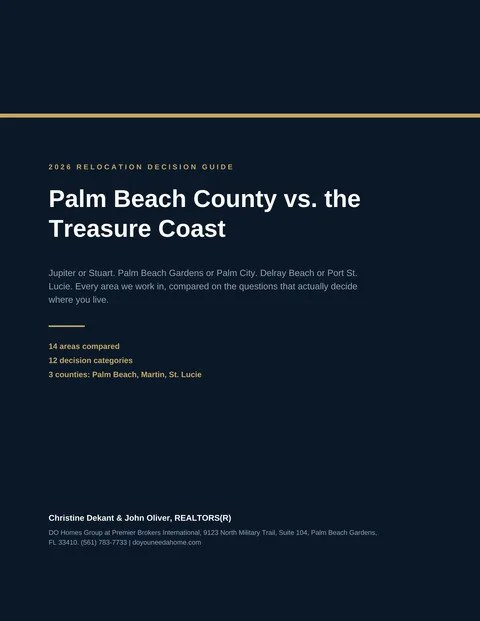
Free Relocation Decision Guide
Palm Beach County or the Treasure Coast?
A side-by-side comparison of 14 areas we actually work in — from Boca Raton to Port St. Lucie — across 12 things that decide where you should live.
Property taxes: the seller's bill isn't your bill
The tax figure on a listing reflects the seller's assessment and exemptions. The Palm Beach County Property Appraiser says that when a property changes ownership, Florida law requires the appraiser to remove exemptions and reassess the property so the assessed value equals the just or market value, as of January 1 after the purchase. Exemptions move with the owner, not the property.
What that means in practice:
- Estimate your own bill. Search the parcel on the Property Appraiser's site. At the bottom of the property page, its Property Tax Calculator takes your purchase price and whether you plan to homestead, and returns an estimate.
- Homestead exemption. For a permanent residence, the Property Appraiser lists an exemption of up to $50,000 off assessed value. You must own and live in the home as of January 1, and file by March 1 of that year.
- Assessment caps. The Property Appraiser says homesteaded assessments are capped at a maximum of 3% a year and non-homestead properties at 10% a year, starting the year after purchase.
- Portability. If you're leaving another Florida homestead, ask the Property Appraiser about portability; its site has a portability calculator.
- Paying the bill. The Tax Collector lists property taxes as payable November 1 to March 31, with discounts of 4% in November, 3% in December, 2% in January and 1% in February.
Your bill combines county, municipal, school and special-district millage for the parcel. The Property Appraiser's estimate and the actual tax bill are the numbers to use.
Utilities: what the City's rate schedule shows
For most addresses in the city, electric, water and sewer service come from the City of Lake Worth Beach. Its service area also extends beyond city limits in places, so confirm the provider for the specific address.
Electric. The City's residential rate schedule, as posted on September 23, 2026, has three parts:
- A fixed customer charge of $12.93 a month, plus a $5.00 monthly Storm Fund Surcharge on all accounts (effective December 1, 2024).
- Energy charges that step up with usage. For the first 1,000 kWh, base energy is $0.08451 per kWh plus a power cost adjustment of $0.04096, for $0.12547 per kWh in total. For each kWh above 1,000, it's $0.10900 plus $0.05096, or $0.15996 in total.
- A power cost adjustment the City sets for projected three-month periods and reconciles quarterly, so that part of the rate changes.
The schedule lists a residential minimum bill of $43.20. The utility also offers budget billing and a free home energy audit.
Water, sewer and stormwater. The City sets these by rate resolution, published on its water, sewer and storm documents page.
What to do. Ask the seller for a recent year of utility bills, and read the current schedules. Past bills reflect the previous household's usage and the rates at the time, so they're a starting point, not a forecast.
Insurance and resilience
Premiums and availability are decided policy by policy. Possible inputs include the roof's age and condition, electrical and plumbing systems, windows and doors, wind-mitigation features, the flood zone and elevation, the building's construction, and each carrier's own underwriting rules. None of these has an automatic outcome. Ask your licensed agent how each applies to the house you're considering.
- Get quotes for the actual address, during the inspection period. Ask which inspections the carrier requires, such as four-point or wind-mitigation reports.
- Flood is usually separate. The National Flood Insurance Program says most homeowners and renters insurance doesn't cover flood damage. NFIP coverage generally takes effect 30 days after purchase, with exceptions, including when it's bought in connection with making or renewing a mortgage. See FloodSmart.
- A flood zone isn't a full risk assessment. It's a mapping category. Look it up on FEMA's Flood Map Service Center, then ask about the building itself.
- Elevation certificates don't exist for every property. FEMA says one may be on file with the community's floodplain manager, or the seller may have a copy. Otherwise, a land surveyor, engineer or architect can prepare one. See FloodSmart on elevation certificates.
Renovation and historic-district costs
Renovation cost depends on the house, the scope and the contractor, so get property-specific estimates.
In the City's six historic districts, the City says a Certificate of Appropriateness is required before exterior work begins and before a building permit is issued, and most exterior improvements need one. Since July 1, 2026, some projects that no longer need a building permit under state law may still need a City zoning permit and, in a district, a COA.
Requirements depend on the property and the work, and the City doesn't publish a single list of required materials. So before you price a roof, windows, doors or an addition:
- Meet the City's Historic Preservation Division to discuss the project. The City recommends doing this before finalizing designs or buying materials.
- Review the applicable design guidelines and any prior approvals for the house.
- Get estimates for the approved scope, not a generic one.
Condo and HOA costs
For a condominium or HOA property, get the budget, reserve funding, meeting minutes and any special-assessment history. Under Florida law, condominium and cooperative buildings three or more habitable stories tall need milestone structural inspections at set ages, and structural integrity reserve studies. See the state condominium inspection resources.
Everyday costs
We don't publish Lake Worth Beach-specific figures for groceries, fuel or dining, because we haven't found a current, local source that supports them. Your own spending depends on your habits. A few costs are City-set and verifiable:
- Beach parking. The City's parking page, as of September 2026, lists resident beach permits at $65 plus tax (year-round) and $110 plus tax (seasonal), and beach meters at $3.50 an hour on weekdays and $4.00 on weekends.
- Transit. If you'd use Tri-Rail, price your own trip with Tri-Rail's fares and schedule rather than assuming a saving.
Run your real number before you offer
- Jurisdiction and location: confirm city or county, and the exact location, on the parcel record.
- Property tax: run the Property Appraiser's calculator with your price and homestead plans.
- Insurance: get homeowners and flood quotes for the address, and ask about required inspections.
- Utilities: review a recent year of bills and the City's current rate schedules.
- The house: read the inspection, check the systems and permit history, and price the repairs you expect.
- Historic and association rules: check district status, and read HOA or condo documents where they apply.
- Closing, moving and reserves: plan these with your lender and a qualified financial professional.
For the rest of the decision, see the pros and cons of living in Lake Worth Beach, the neighborhood guide, the local guide and Lake Worth Beach vs. nearby cities, or browse current listings on the Lake Worth Beach community page.
Figures, rates and rules on this page were checked on September 23, 2026 against the sources linked, and they change. Verify taxes and exemptions with the Palm Beach County Property Appraiser and Tax Collector, insurance with a licensed agent, flood information with FEMA and your agent, utility rates with the City, and historic requirements with the City's preservation staff.
Community Guide
Neighborhoods, schools, prices, and lifestyle — all in one place.
Lake Worth Market Trends
Live data from the local MLS.
Homes for Sale in Lake Worth Beach
Single-family homes $500k+, updated daily.
Free Relocation Decision Guide
Palm Beach County or the Treasure Coast?
A side-by-side comparison of 14 areas we actually work in — from Boca Raton to Port St. Lucie — across 12 things that decide where you should live.
Free instant PDF · No obligation · See what's inside →
Frequently Asked Questions
How much does it cost to live in Lake Worth Beach?
There's no single number. The cost to own a home depends on the purchase price, your property tax after reassessment and exemptions, insurance quotes for that address, City utility charges and your usage, the house's condition, historic-district status, and any HOA or condo fees. Run those for the specific property.
Will my property taxes be the same as the seller's?
Not necessarily. The Palm Beach County Property Appraiser says a change of ownership removes the seller's exemptions and resets the assessed value to just or market value as of the following January 1. Use the Property Tax Calculator on the parcel's page for an estimate.
How are Lake Worth Beach electric rates set?
The City runs its own electric utility. Its residential schedule has a fixed monthly customer charge, a monthly storm fund surcharge, and energy charges that step up after the first 1,000 kWh, including a power cost adjustment that's reconciled quarterly. Check the City's current schedule and a recent year of bills.
What affects homeowners insurance cost in Lake Worth Beach?
It's decided policy by policy. Possible inputs include the roof, electrical and plumbing systems, windows and doors, wind-mitigation features, flood zone and elevation, construction type, and each carrier's underwriting rules. Get quotes for the actual address during the inspection period.
Do I need flood insurance in Lake Worth Beach?
It depends on the property and your lender. The National Flood Insurance Program says most homeowners policies don't cover flood, and NFIP coverage generally starts 30 days after purchase, with exceptions tied to a mortgage. Check the flood zone, ask about an elevation certificate, and get a quote.
Does renovating in a historic district cost more?
It depends on the property and the work. In the City's six historic districts, a Certificate of Appropriateness is required before exterior work and before a building permit. Meet the City's Historic Preservation Division first, then get estimates for the approved scope.
Keep Reading
This article is provided by DO Homes Group at Premier Brokers International for informational purposes only and does not constitute legal, financial, tax, or investment advice. Market statistics, pricing, availability, HOA fees, and community details change frequently and may have changed since publication. School assignments, boundaries, and ratings may change — verify all school information directly with the appropriate school district, and consult official public safety resources for any crime data relevant to your search. Verify all details independently and consult the appropriate licensed professionals before making any real estate decision. DO Homes Group is committed to Equal Housing Opportunity and does not discriminate on the basis of race, color, religion, sex, handicap, familial status, or national origin.