
 Photo by Ameer Basheer / Unsplash
Home Insurance Rates Are Falling in Palm Beach County. Here Is What Actually Changed.
Illustrative stock photo of tile-roofed houses. Roof age and condition are among the first things an insurer asks about.
For three years, insurance was the number that killed deals in Palm Beach County. A buyer would fall for a house, get a quote on day four of inspections, and walk. Sellers with perfectly good homes sat on the market because the carrying cost scared people off before the price did.
That is finally starting to turn, and September 2026 brought the clearest evidence yet. Here is what was announced, what it means on a real renewal, and what still decides the premium on the specific house you are looking at.
What was actually announced
On September 22, 2026, Florida's Office of Insurance Regulation approved rate decreases for four homeowners insurers. All four apply when a policy renews:
- Vyrd Insurance Co. — down 10.4%, about 26,751 policies
- One Alliance North America Insurance Co. — down 10.4%, about 17,148 policies
- Safe Harbor Insurance Co. — down 4.1%, about 10,501 policies
- Unique Insurance Co. — down 3.2%, about 8,266 policies
That is roughly 62,700 Florida policies getting a lower rate at renewal. In the same release, Insurance Commissioner Mike Yaworsky said he expects more aggressive rate cuts in the near future and going into 2027.
The bigger picture is in the same release. Since January 2024, 48 companies have filed for a rate decrease and 53 more have asked for no change at all. The average homeowners rate request over the most recent 30 days was a 4.8% decrease, compared with a 5.2% increase five years ago. OIR also cites S&P Global data showing Florida was the only state with an average homeowners rate decrease in 2025, down 0.92%, while the national average rose 5.5%.
Separately, Kin Insurance announced on September 14 that it is cutting rates by an average of more than 20% for new and existing policyholders in Palm Beach, Broward and Miami-Dade counties. That is the company's own announcement. It does not spell out which policy types are included or when each policyholder sees the change, so if you are insured with Kin, ask for your specific renewal figure rather than assuming the average.
Why the market turned
The short version: lawsuits and reinsurance.
Before the reforms, property claims in Florida were unusually likely to end up in court, and the cost of that litigation went straight into premiums. The Legislature passed a string of reforms between 2019 and 2024, with the two that mattered most being SB 2-A (December 2022), which ended the transfer of attorney's fees to third parties in property claims, and HB 837 (March 2023), which repealed one-way attorney's fees. OIR's July 2026 stability report credits those changes with a market that now looks very different:
- Florida's domestic insurers posted a pooled combined ratio of 83% in 2025, which OIR calls the lowest in more than a decade. Under 100% means they paid out less in claims and expenses than they collected.
- Preliminary data points to reinsurance costs falling at least 10% for 2026. Reinsurance is what Florida carriers buy to cover a major hurricane, and it is one of their largest costs.
- 21 new companies have been approved to write residential property insurance in Florida since the reforms.
That last point matters more than it sounds. More carriers competing for the same houses is what actually pushes prices down, and it is why the state-backed insurer of last resort is shrinking.
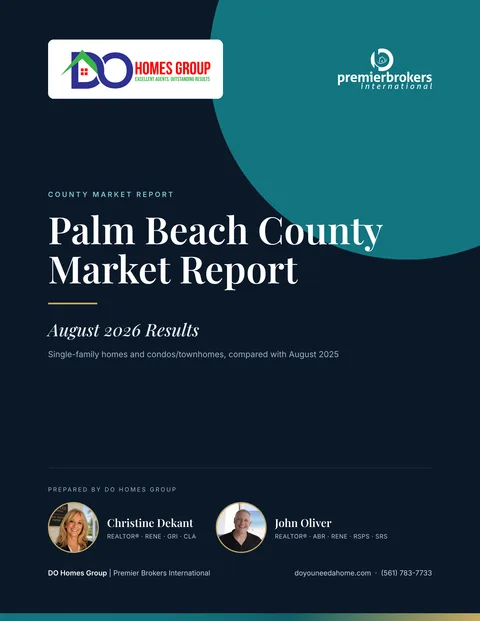
Free — August 2026 Palm Beach County Numbers
What Palm Beach County Homes Actually Sold For
In August 2026, the typical house sold for $650,000 and went under contract in 40 days, at 94.8% of asking. Condos are a different market: 6.7 months of supply and 69 days. See both, and what each means for your offer or your asking price.
Citizens is a fraction of what it was
Citizens Property Insurance had about 1.4 million policies in September 2023. As of September 18, 2026, it was down to about 255,000, according to Citizens president Tim Cerio at the September board meeting, as reported by Florida Realtors. Most of those policies went to private carriers through takeouts and the state's clearinghouse.
If the house you are buying is insured with Citizens today, that does not mean you will be. Florida law (s. 627.351) makes a primary residence ineligible for Citizens when a private insurer offers comparable coverage for no more than 20% above the Citizens premium. New applications also run through a clearinghouse where private carriers get the first look. Cerio's advice to policyholders was blunt: they should shop it.
What a rate cut means on your actual bill
This is where the headlines and the renewal notice part ways.
A rate decrease is a change to that company's filed rate. It applies at renewal, to that company's policyholders, and it is an average across all of them. Your own renewal can still go up if your coverage amount rises with rebuilding costs, if your roof ages into a new bracket, or if your home's characteristics are re-rated.
To put the size of this in context, OIR's July 2026 report puts the average Palm Beach County homeowners premium, including wind, at $6,323, against a statewide average of $3,736. Martin County's average is $5,899. Those are averages across every policy in the county, from a waterfront estate to a small inland house, so they are a scale reference, not a quote. On a $6,323 premium, a 10.4% cut would be about $658 a year. On a 4.1% cut, it would be about $260.
That is real money, and it is moving in the right direction for the first time in years. It is not yet the kind of drop that changes which house you can afford.
What still sets the premium on a specific house
The statewide trend sets the backdrop. The house sets the price. These are the things that move a quote most, and every one of them is something you can check before you make an offer.
The roof. Under s. 627.7011, an insurer cannot refuse to write or renew a policy solely because of roof age if the roof is less than 15 years old. For a roof 15 years or older, the insurer has to let you get an inspection before demanding replacement, and it cannot refuse coverage if that inspection shows at least five years of useful life left. Roof age still affects price, though, so get the permit date early.
The wind mitigation report. Florida insurers are required to offer discounts for features that reduce wind damage: roof-to-wall connections, roof deck attachment, secondary water resistance, opening protection like impact windows or shutters. Those are documented on the state's uniform mitigation form, OIR-B1-1802. A new edition took effect on April 1, 2026, and it now recognizes FORTIFIED roof certificates. A completed form is generally good for up to five years if nothing material changes. OIR does not publish a standard discount percentage, and the difference varies by carrier, so get quotes with and without it.
The four-point inspection. On older homes, insurers usually want a four-point inspection covering roof, electrical, plumbing and HVAC. Citizens requires one on applications for homes more than 20 years old. Private carriers set their own thresholds.
Flood, which is a separate policy. Standard homeowners insurance does not cover flood. If the home is in a FEMA Special Flood Hazard Area and has a mortgage, flood insurance will be required. Citizens has also been phasing in a flood requirement for its policyholders by dwelling value, reaching $400,000 and up in 2026 and every Citizens personal residential policy on January 1, 2027 (condo unit-owner policies and wind-excluded policies are exempt). FEMA's Risk Rating 2.0 now prices each property individually rather than by flood zone alone, so two houses on the same street can get very different flood quotes.
If you are buying a condo
Condo buyers carry a unit-owner policy (HO-6) for the interior and their own belongings, and OIR's July 2026 report puts the Palm Beach County average at $2,311 including wind. The bigger insurance number for a condo is usually the association's master policy, which you pay through your dues and which can change sharply at the association's renewal. Our condo buyer's due-diligence checklist covers what to ask the association for. For building-by-building detail in West Palm Beach and Singer Island, see CondoWPB.com.
If your listing stalled over insurance
If buyers walked from your house because of the insurance quote, the market may be more forgiving now than it was when you listed. It is worth doing three things:
1. Get a current wind mitigation report and put it in the listing documents. If yours is more than a few years old, or if you have added impact windows or a new roof since, a new one may qualify a buyer for credits they cannot otherwise see. 2. Have the roof permit and any roof inspection ready. It is the first thing every buyer's insurance agent will ask for. 3. Get a current quote yourself from an independent agent, using your own mitigation report. Knowing the realistic number for your house lets you answer the question before a buyer's anxiety answers it for them.
The state's My Safe Florida Home program offers free wind mitigation inspections and, for eligible homeowners, matching grants toward hardening. For the 2025-26 program year, grants were limited to low- and moderate-income households with priority for homeowners 60 and older, so check the program site for current eligibility and funding before counting on it.
What to do before you write an offer
- Ask the listing agent for the wind mitigation report, the four-point inspection if the home is older, and the roof permit date.
- Get at least two insurance quotes during your inspection period, not after it. An independent agent can shop several carriers at once.
- Ask each quote to show wind and non-wind premiums separately, along with the hurricane deductible.
- Check whether the home is in a flood zone and get a flood quote even if it is not required.
- For a condo, get the association's current master policy declarations and the date it renews.
Insurance in Florida is still expensive, and a few rate cuts do not change that overnight. What has changed is the direction. For the first time in years, the market is competing for your business again, which means shopping carefully actually pays off.
This article explains how Florida homeowners insurance works and summarizes public announcements. It is not insurance advice. Coverage, pricing and eligibility depend on the specific property and carrier. Get quotes from a licensed Florida insurance agent before you rely on any figure here.
Want the numbers for your own search?
Tell us the price range and the town — we'll walk you through the real monthly cost.
Free — August 2026 Palm Beach County Numbers
What Palm Beach County Homes Actually Sold For
In August 2026, the typical house sold for $650,000 and went under contract in 40 days, at 94.8% of asking. Condos are a different market: 6.7 months of supply and 69 days. See both, and what each means for your offer or your asking price.
Free instant PDF · No obligation · See what's inside →
Frequently Asked Questions
Are home insurance rates going down in Palm Beach County?
The trend is down, but slowly. On September 22, 2026 Florida's Office of Insurance Regulation approved renewal rate decreases of 3.2% to 10.4% for four homeowners insurers covering about 62,700 policies. The 30-day average homeowners rate request statewide was a 4.8% decrease. Kin Insurance separately announced average cuts of more than 20% for Palm Beach, Broward and Miami-Dade policyholders. Your own renewal depends on your carrier and your house.
What is the average home insurance premium in Palm Beach County?
OIR's July 2026 Property Insurance Stability Report puts the average Palm Beach County homeowners premium at $6,323 including wind, and $3,175 excluding wind. The statewide average is $3,736 including wind. These are county-wide averages across all policies, not a quote for any specific home.
Why were Florida home insurance rates so high?
Mainly litigation and reinsurance costs. Property claims in Florida were unusually likely to end up in court, and those costs flowed into premiums. Reforms passed between 2019 and 2024, especially SB 2-A in 2022 and HB 837 in 2023, curbed attorney's-fee rules that drove the litigation. Since then, 21 new insurers have entered the market and reinsurance costs have eased.
Does a wind mitigation inspection lower my insurance?
Often, yes. Florida insurers must offer discounts for wind-resistant features documented on the uniform mitigation verification form (OIR-B1-1802), such as roof-to-wall straps, roof deck attachment, secondary water resistance and impact-rated openings. The size of the discount varies by carrier, so compare quotes with the report. A completed form is generally valid for up to five years if nothing material changes.
Can an insurer refuse to cover a house because the roof is old?
Not solely because of roof age if the roof is under 15 years old. For roofs 15 years or older, Florida law requires the insurer to allow an inspection before requiring replacement, and it cannot refuse coverage if the inspection shows at least five years of useful life remaining. Roof age can still affect the price.
Do I need flood insurance if I have a Citizens policy?
Increasingly, yes. Citizens has phased in a flood insurance requirement by dwelling value, reaching $400,000 and up in 2026, and it applies to all Citizens personal residential policies from January 1, 2027. Condo unit-owner policies and wind-excluded policies are exempt. Homes in a FEMA Special Flood Hazard Area already need flood coverage.
Keep Reading
This article is provided by DO Homes Group at Premier Brokers International for informational purposes only and does not constitute legal, financial, tax, or investment advice. Market statistics, pricing, availability, HOA fees, and community details change frequently and may have changed since publication. School assignments, boundaries, and ratings may change — verify all school information directly with the appropriate school district, and consult official public safety resources for any crime data relevant to your search. Verify all details independently and consult the appropriate licensed professionals before making any real estate decision. DO Homes Group is committed to Equal Housing Opportunity and does not discriminate on the basis of race, color, religion, sex, handicap, familial status, or national origin.