
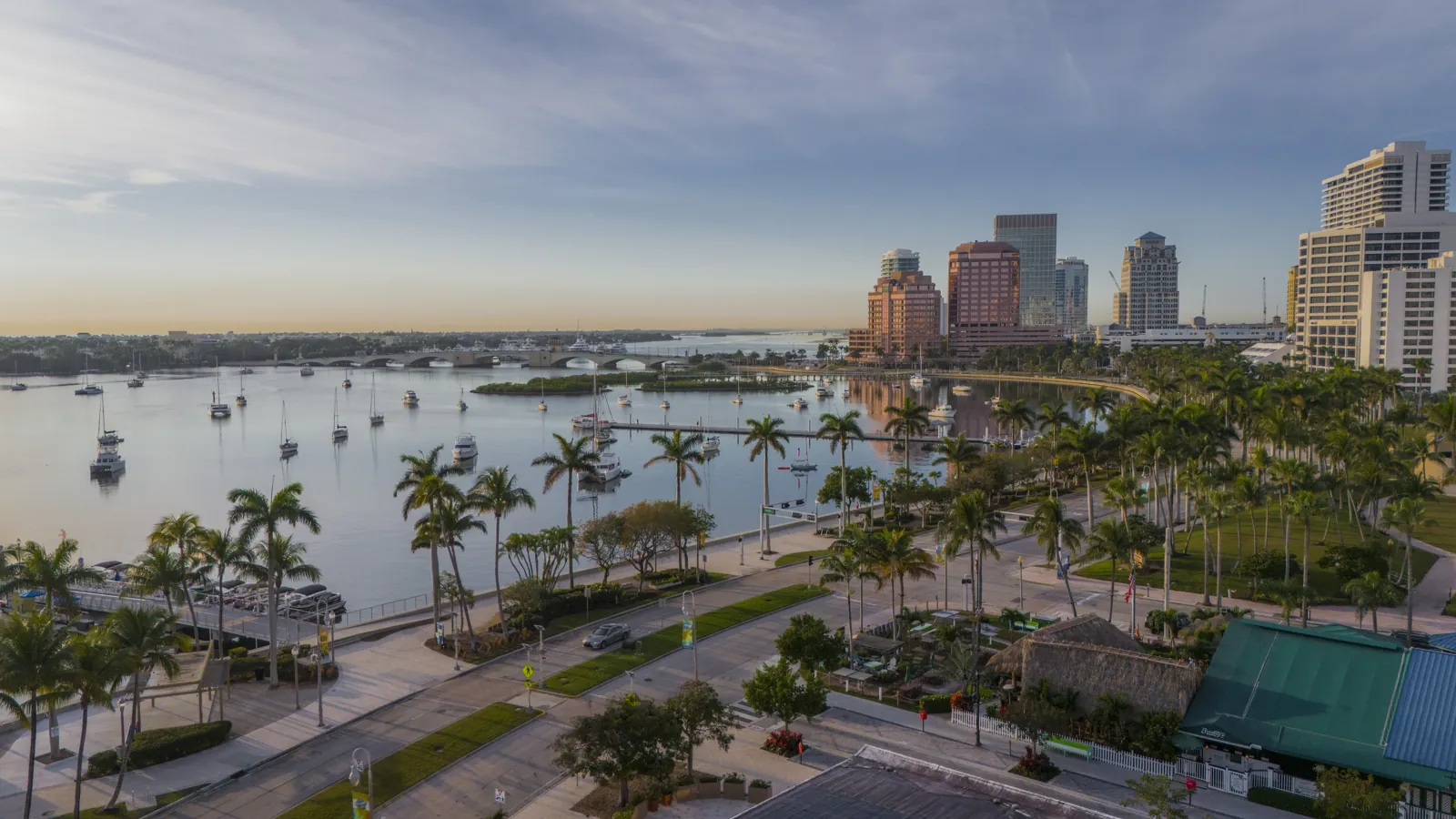
 Photo by John Oliver
Cost of Living in West Palm Beach, Florida: What It Costs to Own Here
The far shore is the Town of Palm Beach, a separate municipality from West Palm Beach.
There's no single cost-of-living number for West Palm Beach. Three different questions tend to get lumped together:
- Cost to purchase: what you pay for the property.
- Cost to own: property tax, insurance, utilities, upkeep and any association fees.
- Cost to live day to day: your ownership costs plus how you actually live, such as driving, parking and transit.
A downtown condominium, an older house in a historic district, a waterfront property and a house farther from the urban core can have very different cost structures. So can two similar houses, depending on their condition, flood zone and the buyer's tax status. This guide shows what drives each cost and what to get before you decide. It isn't tax, insurance, lending, legal or construction advice. For property-specific answers, go to the public authority or licensed professional named in each section.
The cost components
| Cost | What drives it | Get before deciding |
|---|---|---|
| Purchase price | The property, its condition and location | Comparable sales; inspection |
| Property tax | Your price, your exemptions, millage | A Property Appraiser estimate |
| Home insurance | Roof, systems, openings, the carrier | Quotes for the address |
| Flood insurance | Zone, elevation, the building | A flood quote; any elevation certificate |
| Utilities | City rates, FPL rates, your usage | Recent bills; rate schedules |
| Condo or HOA | Budget, reserves, assessments | Budget, reserve study, minutes |
| Upkeep and repairs | Age, condition, past work | Inspection; contractor estimates |
| Historic review | District status and the work | A talk with City preservation staff |
| Parking and travel | The property's parking; your trips | Permits and rates; your routes |
| Move-in and setup | Deposits, moving, closing | Estimates from lender, title, mover |
Some of these depend mainly on the property (its condition, flood zone and association), and some on you (your exemptions, your usage, your trips and your loan).


Free Relocation Decision Guide
Palm Beach County or the Treasure Coast?
A side-by-side comparison of 14 areas we actually work in — from Boca Raton to Port St. Lucie — across 12 things that decide where you should live.
Property taxes: the seller's bill isn't your bill
The tax figure on a listing reflects the seller's assessment and exemptions. The Palm Beach County Property Appraiser's FAQ, checked September 23, 2026, says that when a property changes ownership, Florida law requires the appraiser to remove exemptions and reassess the property so the assessed value equals the just or market value. How that plays out for a particular sale, and in which tax year, is a question for the Property Appraiser.
- Estimate your own bill. Search the parcel on the Property Appraiser's site and use the Property Tax Calculator on the property page. Enter your purchase price and whether you intend to homestead, and it returns an estimate.
- Homestead exemption. The Property Appraiser lists an exemption of up to $50,000 off assessed value for a qualifying permanent residence, with applications due by March 1 of the year you want to qualify. Eligibility depends on your circumstances, so confirm with the Property Appraiser.
- Assessment caps. The Property Appraiser says homesteaded assessments are capped at 3% a year and non-homestead assessments at 10% a year.
- Portability. Florida homeowners can move ("port") their accumulated cap savings from one homestead to another. The Property Appraiser has a portability calculator and can confirm what applies to you.
- Paying the bill. The Tax Collector collects property taxes, and its site lists the payment window and early-payment discounts.
Your bill combines county, City, school and special-district millage for the parcel, and it can also carry non-ad valorem assessments. Use the Property Appraiser's estimate and the actual tax records, not the seller's bill.
Utilities: the City's water, sewer and sanitation rates
Inside city limits, the City of West Palm Beach provides water, sewer, stormwater and sanitation service, and electricity comes from Florida Power & Light, which the City lists as the electric provider. The City's 2025–26 rate schedule, effective October 1, 2025, lists these residential charges per dwelling unit each month:
- Water: a $24.38 service charge, plus usage charges that step up with volume, from $2.83 per unit for the first 8 units (1 unit is 100 cubic feet, or 748 gallons).
- Wastewater: a $16.75 service charge, plus $4.94 per unit of water used, up to 16 units.
- Stormwater: $16.69 (full) or $11.36 (partial), as the schedule lists them.
- Sanitation and recycling: $23.85 for sanitation and $4.84 for curbside recycling. The City's FY2025–26 fee schedule says single-family sanitation includes trash pickup twice a week and yard and bulk pickup once a week.
The schedule also lists a $190 minimum deposit for a residential 5/8-inch meter and a $45 service-initiation fee, and a 25% surcharge for customers outside city limits. Ask the seller for a recent year of utility bills. They reflect that household's usage and past rates, so treat them as a starting point, not a forecast. For electricity, check FPL's current residential rates and the home's recent usage.
Insurance and resilience
Premiums, coverage, underwriting and availability are decided policy by policy. Possible inputs include the roof's age and condition, electrical and plumbing systems, windows and doors, wind-mitigation features, elevation, the flood zone, the building's construction and each carrier's underwriting rules. None of these has an automatic result, so ask your licensed agent how each applies to the property.
- Get quotes for the actual address during the inspection period, and ask which inspections the carrier requires, such as four-point or wind-mitigation reports.
- Flood coverage. The National Flood Insurance Program says most homeowners and renters policies don't cover flood damage. See FloodSmart for how NFIP policies work, including waiting periods, and ask your agent about private options.
- A flood zone isn't a full risk assessment. It's a mapping category. Look it up on FEMA's Flood Map Service Center, then ask about the building itself.
- Not every property has an elevation certificate. One may be on file, or the seller may have a copy. If not, a licensed surveyor, engineer or architect can prepare one.
Condominium costs
A condo's ownership cost depends heavily on the building. The City's parcel data counts about 14,900 condominium units inside city limits, and they vary widely in age, size and association structure. For any unit, get:
- The association budget and dues, and what they cover.
- Reserve funding and any special assessments, past, pending or planned.
- Inspection and reserve-study records. Florida requires milestone structural inspections for condominium buildings of three or more habitable stories, plus structural integrity reserve studies. See the state's condominium inspection resources.
- The insurance structure: what the association's master policy covers under the governing documents, and what you'd need to insure yourself.
- Parking, rental and use rules, and any fees attached to them.
Our condo buyer's checklist lists the documents to request. For building-by-building research on downtown towers, our sister site CondoWPB.com covers each building.
Historic houses and renovation
Renovation cost depends on the house, the scope and the contractor. The age of the house, its condition, past alterations, permit history, historic designation and the work you plan all affect that scope.
The City maintains 18 locally designated historic districts and 46 individually designated sites. Exterior work on those properties is reviewed under the Historic Preservation Ordinance. Depending on the work, that's a staff-level approval, a minor Certificate of Appropriateness approved administratively, or a major one heard by the Historic Preservation Board. What applies depends on the parcel and the work, so:
- Talk to the City's historic-preservation staff (Planner on Call, 561-822-1461) before you finalize a design or buy materials.
- Check the permit history so you know what past work was permitted.
- Get inspections and estimates for the actual scope, not a generic one.
The neighborhood guide lists the historic districts.
Parking, transportation and everyday costs
We don't publish West Palm Beach figures for groceries, fuel or dining, because we haven't found a current local source that supports them, and your spending depends on your habits. Some costs are set by the City or an operator and can be checked:
- Downtown parking. The City's rates page, checked September 23, 2026, lists monthly garage permits at $100 plus tax and a downtown residential garage permit at $80 plus tax (with proof of residency), and meters at $1.00 to $2.50 an hour depending on the zone.
- Local transit. The City's West Palm MOVE lists a $1 fixed-route fare and $2 on-demand rides.
- Regional rail and tolls. Price your own trips with Brightline, Tri-Rail and any toll roads on your route, rather than assuming a saving.
Run your real number before you offer
- Jurisdiction and location: confirm city or county on the parcel record (a parcel number starting with 74 is in the City of West Palm Beach).
- Property tax: run the Property Appraiser's calculator with your price and homestead plans.
- Insurance and flood: get homeowners and flood quotes for the address, and ask about required inspections.
- Utilities: review a recent year of bills and the City's and FPL's current rates.
- The property: read the inspection, check the systems and permit history, and price the repairs you expect.
- Historic and association rules: check district status, and read condo or HOA documents where they apply.
- Parking, transportation, moving and reserves: include them in your plan.
- Professional advice: consult your lender, a licensed insurance agent, and tax or legal professionals for decisions outside real-estate guidance.
For the rest of the decision, see the pros and cons of living in West Palm Beach, the neighborhood guide, the local guide and West Palm Beach vs nearby cities. Browse listings on the West Palm Beach community page or search homes for sale.
Figures, rates and rules on this page were checked on September 23, 2026 against the sources linked, and they change. Verify taxes and exemptions with the Palm Beach County Property Appraiser and Tax Collector, insurance with a licensed agent, flood information with FEMA and your agent, utility rates with the City and FPL, and historic requirements with the City's preservation staff.
Community Guide
Neighborhoods, schools, prices, and lifestyle — all in one place.
West Palm Beach Market Trends
Live data from the local MLS.
Homes for Sale in West Palm Beach
Single-family homes $500k+, updated daily.
Free Relocation Decision Guide
Palm Beach County or the Treasure Coast?
A side-by-side comparison of 14 areas we actually work in — from Boca Raton to Port St. Lucie — across 12 things that decide where you should live.
Free instant PDF · No obligation · See what's inside →
Frequently Asked Questions
How much does it cost to live in West Palm Beach?
There's no single number. The cost to own depends on the purchase price, your property tax after reassessment and any exemptions, insurance and flood quotes for that address, City and FPL utility charges and your usage, the property's condition, historic-district status, and any condo or HOA costs. Run those for the specific property.
Will my property taxes be the same as the seller's?
Not necessarily. The Palm Beach County Property Appraiser says a change of ownership leads it to remove exemptions and reassess the property to just or market value under Florida law. Use the Property Tax Calculator on the parcel's page for an estimate, and confirm your exemption eligibility with the Property Appraiser.
What are the City of West Palm Beach water and sewer rates?
The City's 2025–26 schedule, effective October 1, 2025, lists residential monthly service charges of $24.38 for water and $16.75 for wastewater per dwelling unit, plus usage charges, a stormwater charge, and sanitation at $23.85 with recycling at $4.84. Check the City's current rate schedule and a recent year of bills.
What affects homeowners insurance cost in West Palm Beach?
It's decided policy by policy. Possible inputs include the roof, electrical and plumbing systems, windows and doors, wind-mitigation features, elevation and flood zone, construction type, and each carrier's underwriting rules. Get quotes for the actual address during the inspection period.
What drives the cost of owning a condo in West Palm Beach?
The building. The association's budget and dues, reserve funding, any special assessments, milestone inspection and reserve-study results, the master insurance policy, and parking and use rules all affect it. Get the documents for the specific building before committing.
Does renovating a historic house cost more?
It depends on the house and the work. Exterior work on properties in the City's local historic districts or individually designated sites is reviewed under the Historic Preservation Ordinance, at a level that depends on the project. Talk to the City's preservation staff first, then get estimates for the approved scope.
Keep Reading
This article is provided by DO Homes Group at Premier Brokers International for informational purposes only and does not constitute legal, financial, tax, or investment advice. Market statistics, pricing, availability, HOA fees, and community details change frequently and may have changed since publication. School assignments, boundaries, and ratings may change — verify all school information directly with the appropriate school district, and consult official public safety resources for any crime data relevant to your search. Verify all details independently and consult the appropriate licensed professionals before making any real estate decision. DO Homes Group is committed to Equal Housing Opportunity and does not discriminate on the basis of race, color, religion, sex, handicap, familial status, or national origin.