
Palm Beach Gardens · Local Guide
What It's Really Like Living in Palm Beach Gardens, Florida
The city was drawn on paper before it was built, and it still shows. What that planning gives you, what it costs, and what changes with the exact address.
By John OliverUpdated

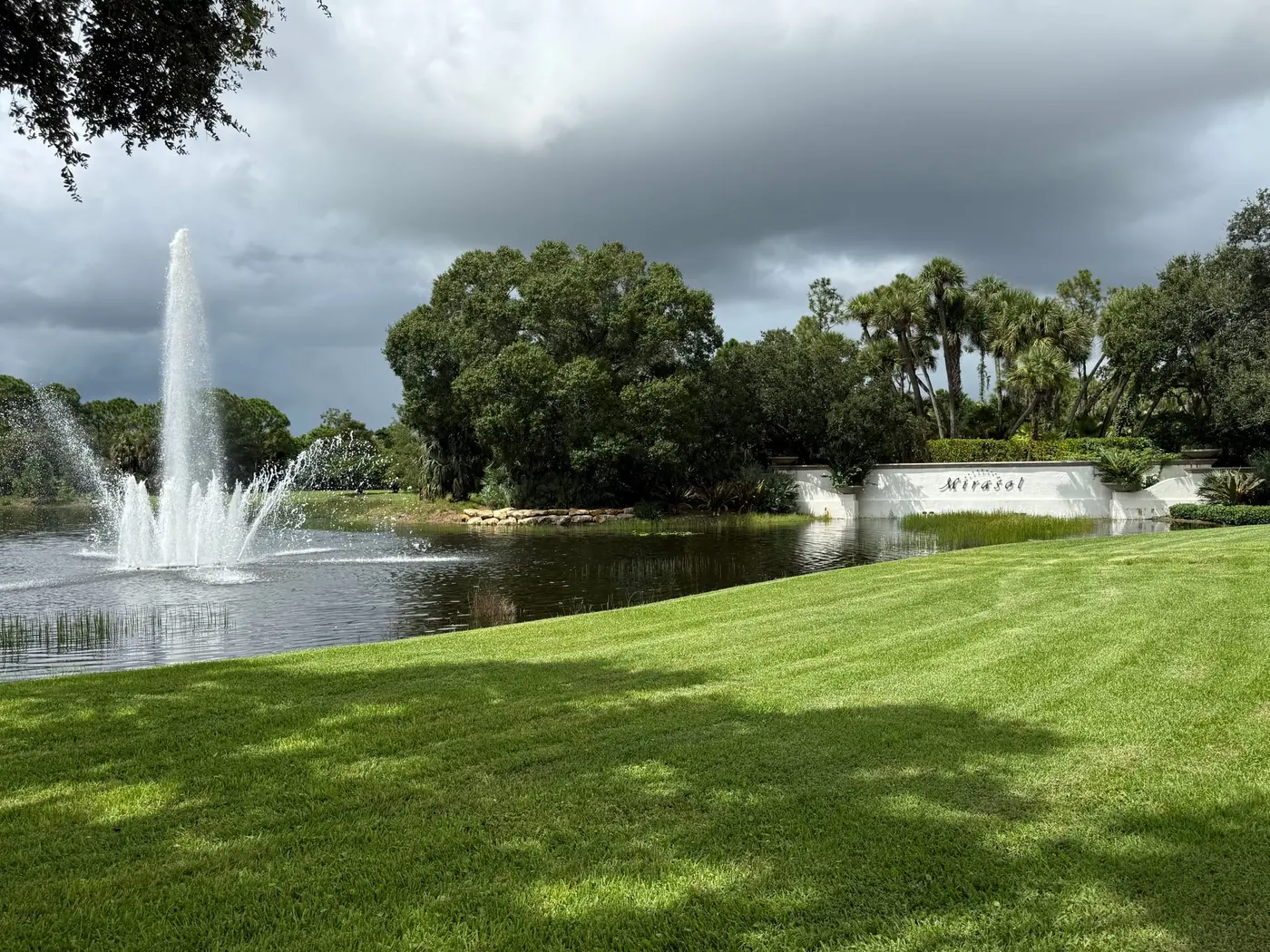
A lake, a fountain and a sign wall at Mirasol, one of the planned communities inside the City of Palm Beach Gardens.
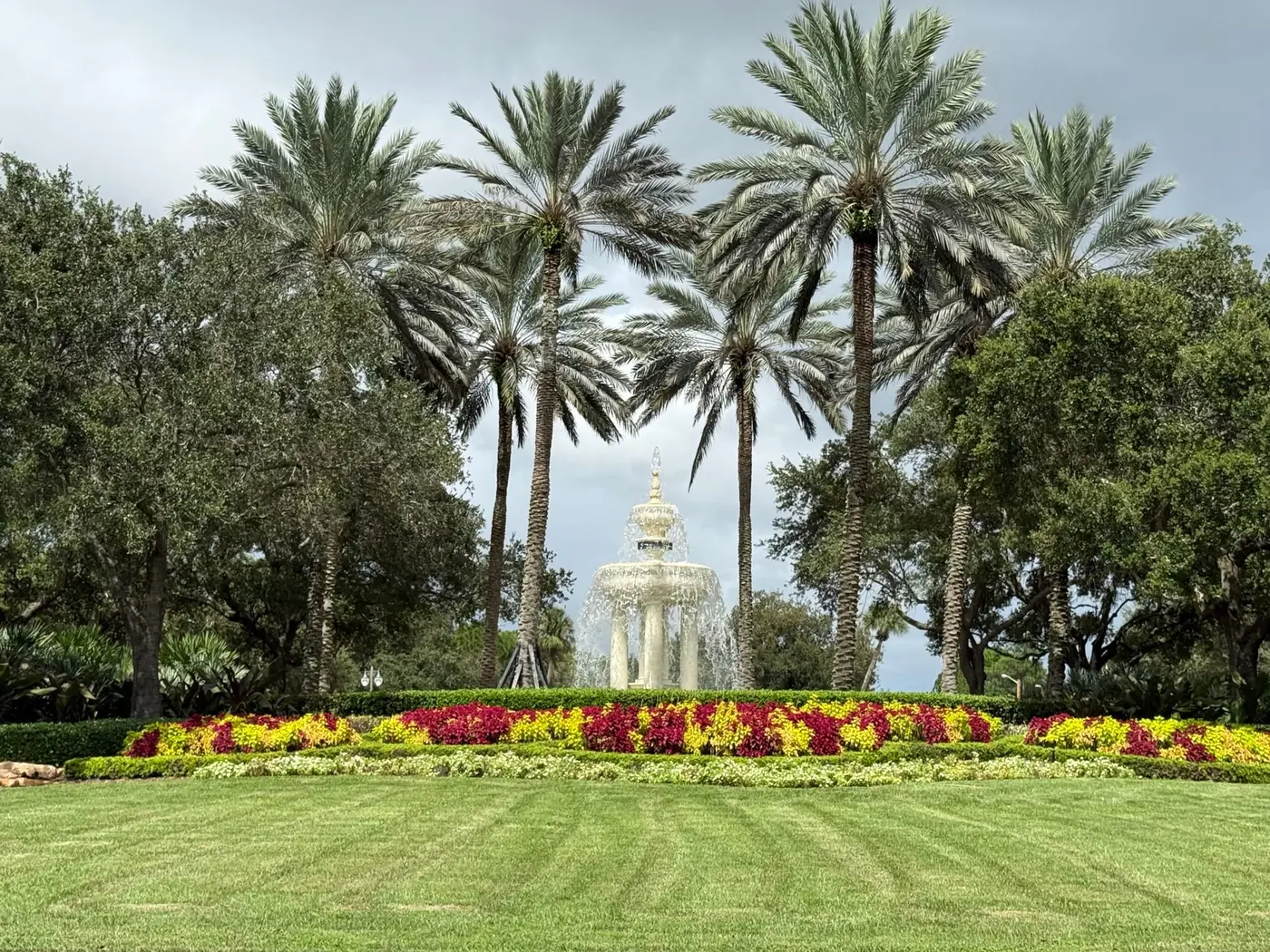
Turn off Interstate 95 onto PGA Boulevard and the first thing you notice is that nothing looks accidental. The medians are planted. The trees along the road are older than the buildings behind them. The neighborhoods sit back behind landscaped entrances rather than fronting the street, and the shopping is gathered into a few large centers instead of strung along every block. Palm Beach Gardens feels intentional because it was planned that way, and sixty-odd years on, the plan still governs how the place looks.
That is the city's real identity, and it cuts both ways. The same planning that makes daily life orderly also means the City is inland, organized around a car, and built largely as a set of communities with their own rules and costs. Whether that reads as composed or as constrained depends on what you want from a home. This guide covers what living here actually feels like, what the planning gives you and takes away, and what to verify for one specific address before you commit to it.
Five things that change the answer
Palm Beach Gardens is not one lifestyle. These are the variables that separate one address from the next.
Whether the parcel is inside the City
A Palm Beach Gardens mailing address can sit in the City, in unincorporated Palm Beach County, or near the line with North Palm Beach, Juno Beach, Jupiter or Lake Park. Taxes, permitting, police, code enforcement and utilities follow the parcel, not the mail.
The community, and what comes with it
Most of the City is built as planned communities. Gated or not, with a mandatory club or without, with a Community Development District or without, each one sets its own dues, rules and approvals.
Your relationship with the beach
The City does not front the Atlantic. The ocean is east of it, in Juno Beach, Jupiter and on Singer Island, and a routine that depends on the beach is a routine that depends on the drive.
Your real routes
Work, school, groceries, the club, medical and the airport, driven at the hours you would actually drive them, on the corridors the City is organized around.
Storm and flood exposure for that parcel
Inland does not mean exempt. The flood zone, the evacuation zone, and wind and flood quotes are property-specific.
In this guide
A city that was drawn before it was built
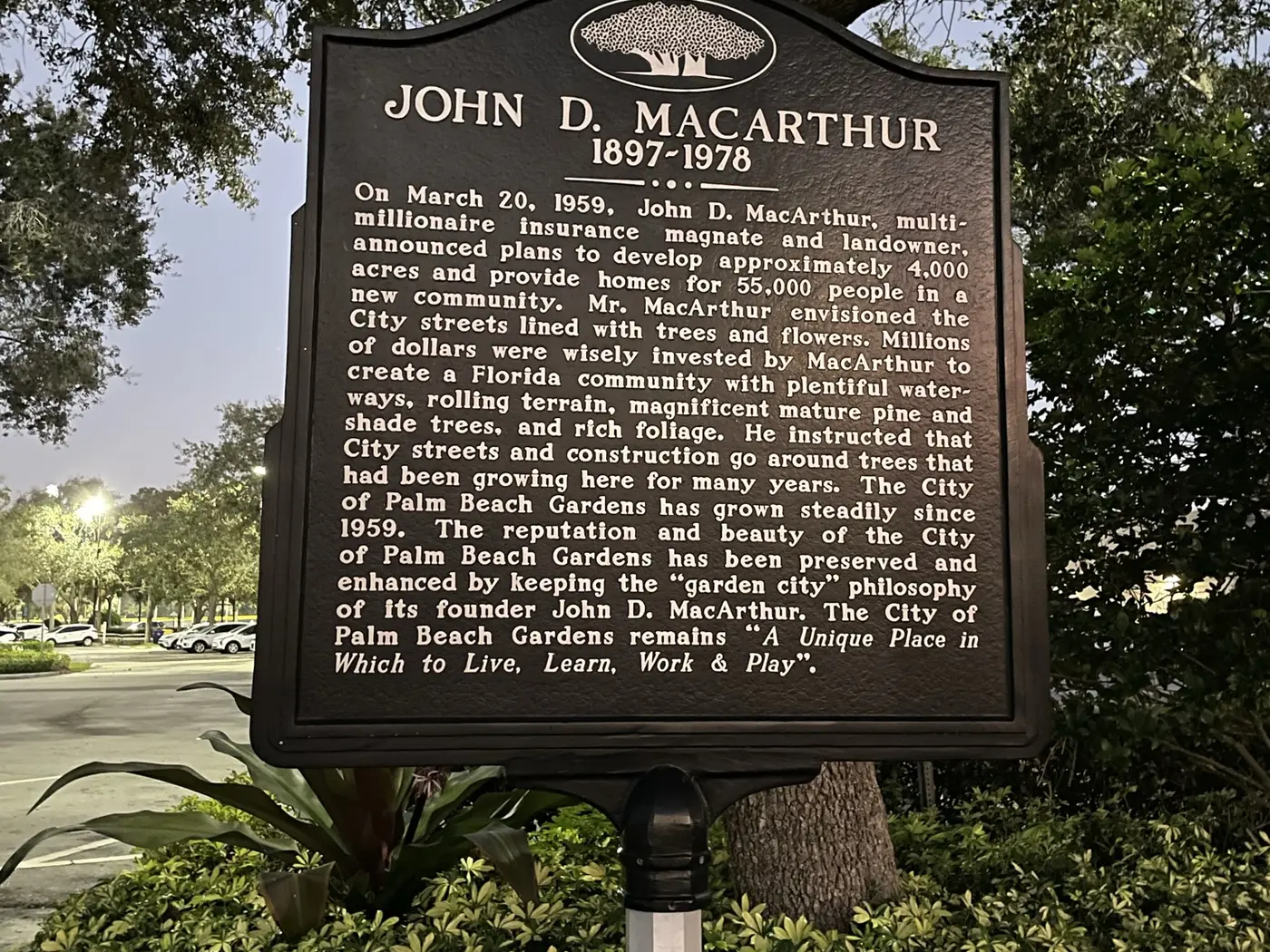
The founding is written on a marker at the City Hall campus on North Military Trail, and it is worth quoting rather than paraphrasing. On March 20, 1959, John D. MacArthur, an insurance magnate and landowner, announced plans to develop approximately 4,000 acres and provide homes for 55,000 people in a new community. He envisioned streets lined with trees and flowers, a community with plentiful waterways, rolling terrain and mature pine and shade trees, and he instructed that streets and construction go around trees that had been growing there for years. The marker calls this the "garden city" philosophy, and the City of Palm Beach Gardens dates its growth from 1959.
The best-known expression of that philosophy is a pair of banyan trees. Per the historical marker on MacArthur Boulevard just north of Northlake Boulevard, MacArthur bought an 80-year-old banyan in Lake Park that was slated for destruction and had it moved there in 1960, and a second, smaller one the following year. The tree is on the City's shield.
The plan was exceeded. The 2020 Census counted 59,182 people inside the City, and the Census Bureau's July 1, 2025 estimate is 63,883, on 58.71 square miles of land, per its QuickFacts page. That land area is a surprise to most people, because the City is much larger than the part you see from PGA Boulevard. It runs well west of Florida's Turnpike, and the western part is mostly open: Palm Beach County's Loxahatchee Slough Natural Area, 13,025 acres north and south of PGA Boulevard and the County's largest natural area, the City-owned Sandhill Crane Golf Club, and the Avenir development along Northlake Boulevard, which is still being built.
One correction to what is often repeated, including on an earlier version of this page. The preserved land on the City's western side is County-owned natural area, not conservation easements held by the MacArthur Foundation. The Foundation's own history says MacArthur's Florida real estate holdings were liquidated after his death in 1978, and its Palm Beach County land gifts went to John D. MacArthur Beach State Park, which is in North Palm Beach, and to the Florida Atlantic University campus at Abacoa, which is in Jupiter.
"Palm Beach Gardens" on the mail is not the same as the City
A Palm Beach Gardens mailing address does not tell you who governs the property. The City's own FAQ gives the test: look the address up at the Palm Beach County Property Appraiser, and if the municipality field says Palm Beach Gardens, the parcel is inside the City. If it says something else, it is not, whatever the mail says.
| If the address is in | Who runs it | What that changes |
|---|---|---|
| The City of Palm Beach Gardens | The City: its own council, police department, fire rescue, planning and zoning, building permits and code enforcement. | City zoning, permitting, police, code rules and City ordinances apply. |
| Unincorporated Palm Beach County with Gardens mail | Palm Beach County: the Sheriff's Office, County zoning, County building and County code enforcement. | County rules, County taxes and County services, not the City's. |
| North Palm Beach, Lake Park, Juno Beach or Jupiter | Each is a separate municipality on the County's list of 39. | Its own government, police, permitting and rules. All four border the Gardens mailing area. |
Three ways to settle it for a parcel: the Palm Beach County Property Appraiser record, the County's boundary maps, and the City's GIS Division, which publishes the zoning and future land use maps.
Water and sewer do not follow the City line either. Seacoast Utility Authority serves the City, North Palm Beach, Lake Park, Juno Beach and parts of unincorporated Palm Beach County, so a Seacoast bill does not prove a City address, and some properties in the Gardens area are on wells or septic. Confirm the provider for the address rather than assuming it.
What the development pattern feels like day to day
The City is organized around a few wide corridors, and almost everything you do runs along them: PGA Boulevard, Northlake Boulevard, Donald Ross Road and Military Trail, with Interstate 95 and Florida's Turnpike both crossing the City north to south. Between the corridors, the housing is built as communities, most with a single landscaped entrance, many with a gate, and each with its own association. You do not drive through a Palm Beach Gardens neighborhood on the way to somewhere else; you drive to its entrance.
The retail is gathered the same way. The Gardens Mall, 3101 PGA Boulevard, opened in 1988 and describes itself as a 1.4 million square foot regional center. Downtown at the Gardens, 11701 Lake Victoria Gardens Avenue, is an open-air center of shops and restaurants beside it. PGA Commons sits on the south side of PGA Boulevard between Interstate 95 and the Turnpike, with restaurants, galleries, offices and apartments. Alton Town Center, 5320 Donald Ross Road, serves the north side of the City. Each is a destination you drive to and then walk around. The eat, drink and hang out guide covers the restaurants district by district.
The City runs a lot of the public side of daily life itself. The Recreation Department operates the Burns Road Community Center at 4404 Burns Road, the aquatic complex beside it, and the tennis and pickleball center on 117th Court North. The Gardens GreenMarket runs on Sundays in season at the City Hall campus, 10500 North Military Trail; the City's page carries the current season's dates. Palm Beach Gardens Medical Center, 3360 Burns Road, is a 199-bed acute care hospital inside the City.
What the pattern does not give you is a traditional downtown: no main street that grew up over a century, no block that feels improvised, no walk from a front door to a corner store in most of the City. The consistency is the product. Some people find it restful and some find it flat, and it is worth knowing which you are before you buy.
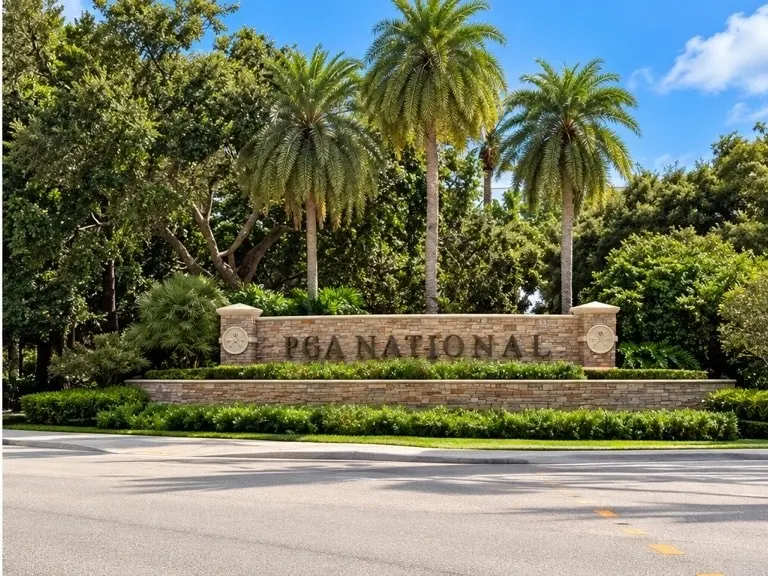
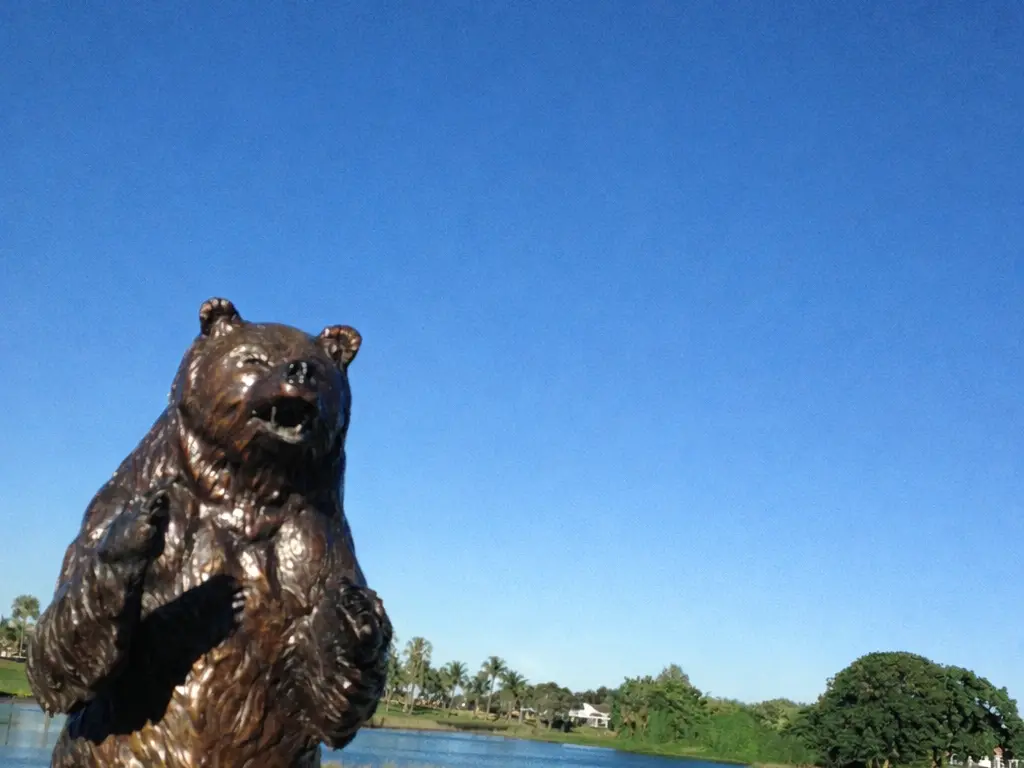
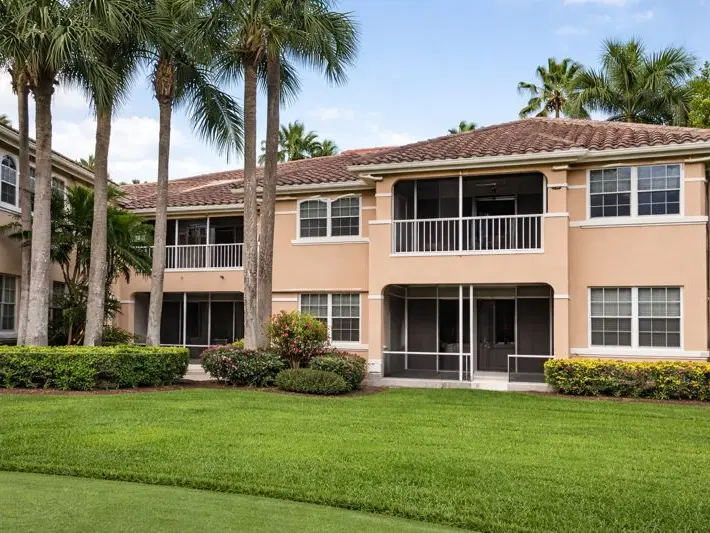
Planned landscapes in Palm Beach Gardens
The beach question, plainly
The City of Palm Beach Gardens does not front the Atlantic Ocean. The beaches are east of it: in the Town of Juno Beach, in the Town of Jupiter, and on Singer Island, where John D. MacArthur Beach State Park sits at 10900 Jack Nicklaus Drive, North Palm Beach. Each of those is a separate municipality or a state or County park with its own rules, parking and conditions.
This is the point that catches the most people. They picture a Florida beach life, buy in the Gardens because the house, the community or the golf is right, and discover that the beach is a trip rather than a walk. For many people that trade is exactly right: a home base that is quiet, organized and well served, with the sand reachable when they want it. For someone who wants to be on the beach every morning, it is the wrong town, and no amount of landscaping changes that. Be honest with yourself about the difference between "the beach is east of here" and "I live at the beach." They produce different lives.
We don't publish drive times to the beach, because the answer depends on where in 58 square miles you start, which road you take, the season and the hour. Drive it yourself, from the address you are considering, on a weekend morning in season.
Water inside the City is a different kind. Many communities are built around lakes, some of them large. The County's Loxahatchee Slough kayak launch at 8311 PGA Boulevard puts a paddle trail at the western edge of town. The Intracoastal Waterway and its marinas lie to the east, mostly in the neighboring towns. If a dock or a boat is part of the plan, the neighborhoods guide sorts out which addresses can offer it and which cannot.
Golf shapes the city, described accurately
You cannot describe Palm Beach Gardens honestly without golf, and you cannot describe the golf honestly without a correction. An earlier version of this page said the PGA of America moved its national headquarters to the City in 2023. The opposite happened. The PGA of America had been headquartered in Palm Beach Gardens, announced in December 2018 that it would relocate to Frisco, Texas, and opened its new headquarters there on August 22, 2022.
What the City legitimately hosts is still substantial. PGA National Resort is inside the City, and its Champion Course, originally designed by Tom and George Fazio and later redesigned by Jack Nicklaus, is the home of the PGA TOUR's Cognizant Classic in The Palm Beaches, the tournament long known as the Honda Classic. The TOUR has played it at PGA National since 2007, and the Bear Trap, holes 15 through 17, is the stretch the broadcasts are built around. Our PGA National community guide covers the villages around the courses.
For a resident, the courses matter less than the structure they create. A large share of the City's housing sits inside golf and country club communities: PGA National, Mirasol, BallenIsles and others. In some of them, club membership is mandatory with the purchase; in others it is optional; in a few, the club and the association are separate entities with separate bills. Joining costs, annual dues, food minimums and what happens to a membership on resale are set community by community, and they are the single biggest reason two similar houses a mile apart can cost very different amounts to own. The cost of living guide walks through those lines.
If you do not play, there is still public golf: the City's own Sandhill Crane Golf Club, 9500 Sandhill Crane Drive, with a par-3 course beside it. But you should still understand the club structure before you buy, because in many communities you will pay for it whether you play or not.
Golf carts are part of the picture, with a rule attached. Inside many communities, the cart is how people get to the club, the courts and a neighbor's house, on private streets the community controls. On public roads, Florida law allows golf carts only where the City or County has designated and signed a street for them, per section 316.212, Florida Statutes, and a local ordinance can be stricter. Whether you can cart to the store from a given address is a question for that community's documents and the City, not an assumption.
Getting around
A car is practical for most of daily life in the City. Home, work, school, the club, groceries, medical and the beach tend to sit on different corridors, and the corridors are built for driving. That is not the same as having no transit. Palm Tran runs Route 1 along US-1, Route 20 along Northlake Boulevard to downtown West Palm Beach, Route 33 to the Gardens Mall, and Route 10 between the City and Jupiter; whether any of them fits a routine depends on the exact address and the current schedule, which Palm Tran changes from time to time.
There are more walkable pockets, and they are specific. Alton, on Donald Ross Road, was designed by its builder around walkable streets and a retail center. Downtown at the Gardens and PGA Commons are places to park once and walk. But these are pockets inside a car-oriented city, not the city's character, and a listing that says "walkable" deserves a walk from the front door before you believe it.
We don't publish drive times, including seasonal comparisons or a number for the airport, because they depend on where you start, the route and the hour. Test your actual routes at the times you would use them:
- The commute, both directions, on a weekday, including the Interstate 95 and Turnpike interchanges you would rely on.
- School drop-off and pickup, if that applies.
- The club, the course or the courts you would use most.
- Groceries, pharmacy and everyday errands.
- Your doctors and any regular appointments.
- The beach you would actually go to, on a weekend morning in season.
- The airport. The commercial airport for the county is President Donald J. Trump International Airport in West Palm Beach, renamed in 2026.
Storm season and the flood map
Inland is not the same as exempt. Hurricane season runs June 1 through November 30, per the Florida Division of Emergency Management, and storms that never make a direct landfall still bring days of rain, wind damage, extended power loss and, in some years, evacuation orders for parts of the county. The City's Hurricane Readiness page carries its resident guide and the utility partners' information.
Flood exposure is set parcel by parcel, not by the ZIP code. The City notes that FEMA's current flood maps for Palm Beach Gardens took effect October 5, 2017; look the parcel up at the FEMA Map Service Center, ask whether an elevation certificate exists for the structure, and get written wind and flood quotes before the inspection period ends. A lake lot in a planned community is still a lot beside water, and the insurer will price it as the parcel, not as the city.
The rules that come with the deed
Because so much of the City is built as communities, the documents matter more here than in most towns. Before you offer, read:
- The association documents: budget, reserves, current and pending assessments, and the rules on rentals, pets, parking, exterior changes, generators and golf carts.
- The club documents, where a club exists: whether membership is mandatory, what it costs to join and keep, and what happens on resale.
- Any Community Development District assessment on the parcel's tax record. Some communities carry one and most older ones do not. The tax bill says which.
- For a condominium of three or more habitable stories, the milestone inspection and the structural integrity reserve study.
- The municipality and the utility provider, confirmed as above, and whether the home is on municipal sewer or septic.
- The homestead picture. If the home will be your permanent residence, the Palm Beach County Property Appraiser explains the exemption and its March 1 deadline. The seller's tax bill is not a forecast of yours.
The trade-offs, address by address
Every city has trade-offs. Palm Beach Gardens' are specific, and most attach to the community rather than to the city:
- Ownership cost varies widely. Association dues, club obligations, any district assessment, insurance and the home's condition move the number far more than the city name does.
- A car is practical for most routines, and the handful of walkable pockets are the exception that proves it.
- The beach is a trip, not a feature of the address. Juno Beach, Jupiter and Singer Island are east of the City, each under its own rules.
- The planning is the character. You get order, landscaping and consistency. You do not get a historic downtown, an improvised block or much variety from one street to the next.
- Storm, flood and insurance diligence is part of ownership here, lake lots included.
- Community, club and district obligations are not interchangeable. A condo near PGA Boulevard, a house in a non-gated subdivision, a club community with a mandatory membership and a new build in Avenir are four different lives with the same mailing address.
Whether those trade-offs are worth it is your call, for your priorities and one specific property. The pros and cons guide takes each one further.
Which built environment fits, and which may not
Palm Beach Gardens may be worth a close look if you're prioritizing:
- A planned community with a landscaped entrance, an association and predictable surroundings, and you have read what the documents require.
- Golf or club life as part of the routine, or at least an understanding of what the club structure costs where you buy.
- A home base near the PGA Boulevard retail and medical centers, with the beach as an outing rather than a daily walk.
- A car-based routine on wide corridors, with a walkable pocket as a bonus rather than a requirement.
You may want to compare other areas if you need:
- The ocean, the Intracoastal or a marina within a walk of the front door.
- A traditional downtown with a grid you can live in on foot.
- A home with no association, club or district in the picture at all.
- Variety and improvisation in the streetscape over consistency.
Neither list is better than the other. They describe built environments, not people, and our practical fit guide and Palm Beach Gardens vs nearby cities compare the alternatives.
The bottom line
Palm Beach Gardens delivers what its founder's marker promised: a city of planted streets, waterways and communities set back behind trees, run deliberately, with the retail and the hospital gathered where you can reach them. It also delivers the consequences of that plan: a car, an association, often a club, and a beach that belongs to the next town over. Get the specifics for one property, from the municipality to the club documents to the flood map, and the rest of the picture tends to take care of itself.
For more, read the Palm Beach Gardens community guide, the local guide, the neighborhoods guide and the cost of living guide.
Community Guide
Neighborhoods, schools, prices, and lifestyle — all in one place.
Palm Beach Gardens Market Trends
Live data from the local MLS.
Homes for Sale in Palm Beach Gardens
Single-family homes $500k+, updated daily.
Next step
Weighing a specific Palm Beach Gardens address? Start with the community guide, or talk with us about the property and the questions above.
Frequently Asked Questions
Does a Palm Beach Gardens mailing address mean the home is inside the City?
No. The mailing area reaches into unincorporated Palm Beach County and borders North Palm Beach, Lake Park, Juno Beach and Jupiter, which are separate municipalities. The City's own test is the Palm Beach County Property Appraiser record: if the municipality field says Palm Beach Gardens, the parcel is in the City. Taxes, permitting, police and code enforcement follow that answer, not the mail.
Is Palm Beach Gardens on the beach?
No. The City does not front the Atlantic Ocean. The beaches are east of it, in the Town of Juno Beach, the Town of Jupiter, and on Singer Island, where John D. MacArthur Beach State Park sits in North Palm Beach. We do not publish drive times; test the trip from the address you are considering, on a weekend morning in season.
Who founded Palm Beach Gardens?
John D. MacArthur. Per the historical marker at the City Hall campus, he announced plans on March 20, 1959 to develop approximately 4,000 acres with homes for 55,000 people, and instructed that streets and construction go around existing trees. The City dates its growth from 1959. The 2020 Census counted 59,182 residents, and the Census Bureau's July 1, 2025 estimate is 63,883.
Is the PGA of America headquartered in Palm Beach Gardens?
Not anymore. The PGA of America was headquartered in the City, announced in December 2018 that it would move to Frisco, Texas, and opened its new headquarters there on August 22, 2022. PGA National Resort remains inside the City, and its Champion Course hosts the PGA TOUR's Cognizant Classic in The Palm Beaches, formerly the Honda Classic, played there since 2007.
Can I drive a golf cart on the streets in Palm Beach Gardens?
Inside many communities, on private streets, yes, under that community's rules. On public roads, Florida law allows golf carts only where the City or County has designated and signed a street for them, and a local ordinance can be stricter. Check the community documents and the City before counting on it.
Is Palm Beach Gardens car-dependent?
A car is practical for most routines, since home, work, the club, groceries, medical and the beach tend to sit on different corridors. Palm Tran runs Route 1 on US-1, Route 20 on Northlake Boulevard, Route 33 to the Gardens Mall and Route 10 to Jupiter; whether one fits depends on the exact address and the current schedule. Alton, Downtown at the Gardens and PGA Commons are walkable pockets inside a car-oriented city.
What should I verify before buying in a Palm Beach Gardens community?
The association budget, reserves, assessments and rules; whether a club membership is mandatory and what it costs to join, keep and resell; any Community Development District assessment on the tax record; the milestone inspection and reserve study for a condominium of three or more habitable stories; the municipality and utility provider; the FEMA flood zone and written wind and flood quotes; and the homestead picture for your own ownership.
Keep Reading
- A Local's Guide to Palm Beach Gardens, Florida →
- Best Neighborhoods in Palm Beach Gardens, Florida →
- Cost of Living in Palm Beach Gardens, Florida →
- Pros and Cons of Living in Palm Beach Gardens, Florida →
- Is Palm Beach Gardens, Florida a Practical Fit for Your Day-to-Day Priorities? →
- Palm Beach Gardens vs Nearby Areas: How to Compare Properties, Not Just City Names →
This article is provided by DO Homes Group at Premier Brokers International for informational purposes only and does not constitute legal, financial, tax, or investment advice. Market statistics, pricing, availability, HOA fees, and community details change frequently and may have changed since publication. School assignments, boundaries, and ratings may change — verify all school information directly with the appropriate school district, and consult official public safety resources for any crime data relevant to your search. Verify all details independently and consult the appropriate licensed professionals before making any real estate decision. DO Homes Group is committed to Equal Housing Opportunity and does not discriminate on the basis of race, color, religion, sex, handicap, familial status, or national origin.