
 Photo by FilterGrade / Unsplash
Cost of Living in Boynton Beach, Florida: What to Budget Before You Buy
Representative image of a Florida planned-community street. The location is not identified, and it is not presented as Boynton Beach. Photo by FilterGrade / Unsplash.
The cost of living in Boynton Beach, Florida, for a homeowner, depends far more on the specific property than on the city. The purchase price is only one part of affordability. Taxes after purchase, insurance, flood coverage, association and club obligations, utilities, upkeep and, for some buyers, a boat decide what a home actually costs to own — and those can differ sharply between two homes at a similar price.
This guide doesn't publish citywide averages or percentage estimates. It sets out what to budget, where each number comes from, and the order to collect them in before you make an offer.
Start with the jurisdiction
A Boynton Beach mailing address can be inside the City of Boynton Beach or in unincorporated Palm Beach County. That affects which taxing authorities apply, who permits work on the home, and which utility rates apply. The City's FY 2026 utility rate sheet lists separate rates for customers inside and outside City limits, and some addresses are served by other providers. Confirm the jurisdiction with the County's municipal boundary maps before estimating anything else.
East and west: different cost profiles
East Boynton has much of the older housing — mid-century single-family homes, older condos, and canal and Intracoastal property. Here the costs that deserve careful review tend to be tied to the building itself: roof age and type, wind-mitigation features, major systems, flood exposure, and, on the water, seawalls and docks.
West Boynton is mostly planned communities built later, many with shared amenities. Some are gated, some include mandatory club membership, and some are age-restricted (55+) communities. Here the costs that deserve careful review tend to be tied to the community: HOA dues, club dues and any buy-in, food-and-beverage minimums, transfer fees and special assessments.
Neither profile is cheaper by default. A lower price with high recurring obligations can cost more to own than a higher price with low ones. Our neighborhood guide describes the areas in more detail.
Budget before you offer
| Cost | Source of the number | Ask for |
|---|---|---|
| Closing | Lender and title company | Loan Estimate |
| Taxes | Property Appraiser | Estimate at market value |
| Insurance | Licensed agent | Address-specific quotes |
| Flood | Agent, FEMA map, lender | Zone and quote |
| Community | HOA, condo or club | Budget, fees, assessments |
| Utilities | City or other provider | Current rate schedule |
| Upkeep | Inspector and contractors | Roof and systems ages |
| Boat | Marina or storage operator | Current rates and availability |
Purchase and closing costs
Closing costs depend on the loan, the lender, the title company and the contract. If you're financing, your lender must give you a Loan Estimate after you apply and a Closing Disclosure before closing; compare them line by line. Ask your title company and lender what the cash to close includes, including prepaid insurance and any tax escrow.
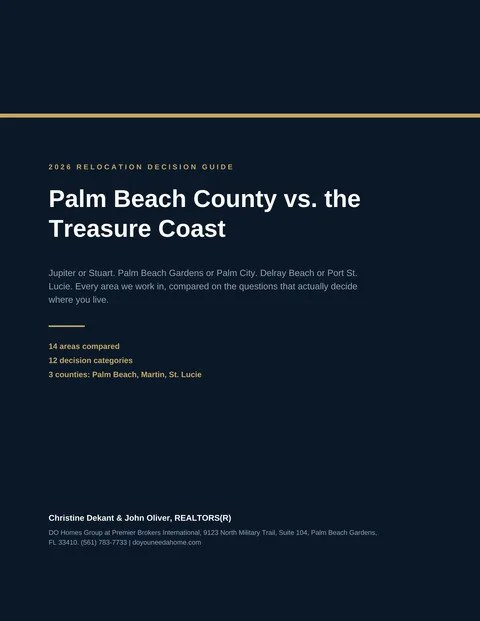
Free Relocation Decision Guide
Palm Beach County or the Treasure Coast?
A side-by-side comparison of 14 areas we actually work in — from Boca Raton to Port St. Lucie — across 12 things that decide where you should live.
Projected property taxes
Florida doesn't impose a personal income tax, but property taxes depend on the property and the taxing authorities that apply to it.
The seller's tax bill is not a reliable estimate of yours. When a property changes ownership, the Property Appraiser removes the prior owner's exemptions and reassesses the property so its assessed value equals market value. Millage rates, assessed values and exemptions can also change from year to year. Ask for a property-specific estimate rather than relying on the seller's bill, and use the Tax Collector's property tax guide to understand how the bill is built.
Homestead, Save Our Homes and portability apply only to a qualifying permanent residence, and each has to be applied for:
- Homestead exemption: can reduce taxable value by as much as $50,000 for a qualifying permanent residence. See the Florida Department of Revenue's exemptions page and the Property Appraiser's exemption page for eligibility and the filing deadline.
- Save Our Homes: limits annual increases in a homestead's assessed value after the exemption is in place. It resets when ownership changes.
- Portability: may let an owner leaving a Florida homestead transfer part or all of the accumulated benefit, up to $500,000, to a new Florida homestead, subject to timing rules and an application. See the Property Appraiser's portability page.
None of these apply to a second home or an investment property, and how they apply to you depends on your circumstances. Confirm with the Property Appraiser and your own tax adviser.
Homeowners and wind insurance
Insurance is property-specific, so get quotes for the exact address early and review them with a licensed insurance professional. Items to review:
- Insurer availability and underwriting for the specific property.
- Coverage limits and deductibles, including any separate hurricane deductible.
- Roof age, type and condition. On older east-side homes especially, this can affect both the premium and whether coverage is available.
- Wind-mitigation features such as roof-to-wall connections and opening protection. The Office of Insurance Regulation's wind mitigation resources explain how these are documented.
- Year built and construction type.
The Office of Insurance Regulation's consumer resources include a rate comparison tool and a consumer helpline.
Potential flood coverage
Most homeowners policies don't cover flooding, so flood coverage is commonly a separate policy or endorsement. The Office of Insurance Regulation's flood insurance page explains the NFIP and private options, and notes that some policies take time to take effect.
Whether flood coverage is required depends on the property's mapped flood zone, the loan and the lender — not simply on whether the home is on the water. Being outside a mapped high-risk zone doesn't mean there's no flood risk. For any property:
- Check the flood zone on FEMA's Flood Map Service Center.
- Ask your lender about its flood requirements.
- Ask the seller for any elevation certificate, flood-claims history and existing policy.
- Get a flood quote, whether or not coverage is required.
HOA, condo and club obligations
Association costs are community-specific and can change. Two similar homes in nearby communities can carry very different annual costs depending on the HOA budget, whether club membership is mandatory, whether there's a buy-in or equity structure, and whether there are food-and-beverage minimums, capital contributions or transfer fees. This is a cost that deserves careful review before you compare prices.
Ask for, in writing:
- The current budget and the full schedule of recurring fees.
- Reserve information, the assessment history and any planned special assessments.
- The governing documents, rules and recent meeting minutes.
- For a club: the membership structure, buy-in, dues, minimums and resale or transfer terms.
- For an age-restricted community: its current status as housing for older persons and its eligibility and occupancy rules.
Condos. Florida requires milestone inspections and structural integrity reserve studies (SIRS) for residential condominium and cooperative buildings three or more habitable stories in height. The state's milestone inspection and SIRS page explains which buildings are covered. For a covered building, ask for the inspection reports, the SIRS and how the association plans to fund the work it identifies. For any condo, a low monthly fee isn't necessarily a saving if reserves or major repairs are unfunded, so review the documents with your advisers.
Utilities, maintenance and commuting
- Utilities: confirm the water, sewer, trash, electric and internet providers for the address, and use their current rate schedules. For City customers, the City's utilities page has billing and service information. Ask the seller for recent bills as a reference, bearing in mind that usage varies by household and season.
- Roof and major systems: ask the ages of the roof, air conditioning, water heater, plumbing and electrical, and get contractor estimates for anything an inspector flags as near the end of its life.
- Waterfront extras: seawall, dock and lift condition, and any permits needed for repairs.
- Commuting: fuel, tolls, parking or transit for your routine. Tri-Rail's Boynton Beach Station is at 2800 High Ridge Road. Test your regular routes at the hours you'd use them.
Optional: boat costs
If the water is part of why you're buying, price the whole cost of keeping a boat rather than just the slip: dockage or dry storage, maintenance, insurance and haul-outs. Check current rates and availability with the marina or storage operator you'd use. Palm Beach County currently lists its Ocean Inlet Park marina as temporarily closed, so don't assume a public slip is available.
Your buyer worksheet
- Jurisdiction confirmed: City of Boynton Beach or unincorporated Palm Beach County.
- Loan Estimate reviewed, and cash to close confirmed with lender and title.
- Property-specific tax estimate at market value, with exemptions you may qualify for noted separately.
- Homeowners and wind quotes, with deductibles, for the exact address.
- Flood zone checked, lender requirements confirmed and a flood quote obtained.
- HOA, condo and club budget, fees, reserves and assessment history in writing.
- Utility providers and current rate schedules confirmed.
- Roof and major-system ages known, with estimates for near-term work.
- Commuting and, if relevant, boat costs priced.
The order of operations
- Step 1: Verify the taxes. Get a property-specific estimate based on reassessment, not the seller's bill.
- Step 2: Get insurance quotes for the address, including wind and flood.
- Step 3: Collect the association documents and every recurring and one-time obligation in writing.
- Step 4: Understand the roof and condition, including any work that affects insurability or near-term budget.
- Step 5: Then compare alternatives — the other side of I-95, a different property type, or a nearby city — on the same total monthly cost.
Our comparison with nearby cities covers how the neighbors differ, the pros and cons guide covers the non-financial tradeoffs, and the local guide covers daily life. When you're ready to look at homes, start from the Boynton Beach community guide.
Figures, rates and rules change. Verify tax, exemption and portability specifics with the Palm Beach County Property Appraiser and Tax Collector, insurance and flood coverage with a licensed insurance professional, loan and closing costs with your lender and title company, and all association and club obligations with the community's governing documents. This guide is general information, not tax, insurance, lending, legal or investment advice.
Community Guide
Neighborhoods, schools, prices, and lifestyle — all in one place.
Boynton Beach Market Trends
Live data from the local MLS.
Homes for Sale in Boynton Beach
Single-family homes $500k+, updated daily.
Free Relocation Decision Guide
Palm Beach County or the Treasure Coast?
A side-by-side comparison of 14 areas we actually work in — from Boca Raton to Port St. Lucie — across 12 things that decide where you should live.
Free instant PDF · No obligation · See what's inside →
Frequently Asked Questions
Is Boynton Beach cheaper to live in than nearby cities?
It depends on the property, not just the city. Purchase price is only one part of affordability; taxes after purchase, insurance, flood coverage, association and club fees, utilities and upkeep can make a lower-priced home cost more to own than a higher-priced one. Compare current, like-for-like properties on total monthly cost for each specific address.
Why might my property taxes differ from the seller's?
When a property changes ownership, the Palm Beach County Property Appraiser removes the prior owner's exemptions and reassesses the property to market value. Millage and exemptions can also change. Ask for a property-specific estimate rather than relying on the seller's bill, and confirm any exemptions you may qualify for with the Property Appraiser.
How do homestead, Save Our Homes and portability work in Palm Beach County?
They apply only to a qualifying permanent residence and must be applied for. Homestead can reduce taxable value by as much as $50,000; Save Our Homes limits annual increases in a homestead's assessed value and resets on a sale; and portability may let an owner transfer part or all of an accumulated benefit, up to $500,000, from a previous Florida homestead, subject to timing rules. Confirm eligibility with the Property Appraiser and your tax adviser.
Is flood insurance required in Boynton Beach?
It depends on the property's mapped flood zone, the loan and the lender, not simply on whether a home is on the water. Most homeowners policies don't cover flooding, so evaluate flood coverage for every property: check the FEMA flood map, ask your lender about its requirements, request any elevation certificate and get a quote.
What HOA and club costs should I ask about in west Boynton?
Ask for the current budget and full fee schedule, reserve information, assessment history and planned special assessments, the governing documents, and, for any club, the membership structure, buy-in, dues, food-and-beverage minimums and transfer terms. Similar homes in nearby communities can carry very different obligations, so get them in writing before comparing prices.
What order should I verify costs in before making an offer?
Verify the taxes on a reassessed basis, get address-specific insurance and flood quotes, collect the association documents and every recurring and one-time obligation, understand the roof and condition, and then compare alternatives on the same total monthly cost.
Keep Reading
This article is provided by DO Homes Group at Premier Brokers International for informational purposes only and does not constitute legal, financial, tax, or investment advice. Market statistics, pricing, availability, HOA fees, and community details change frequently and may have changed since publication. School assignments, boundaries, and ratings may change — verify all school information directly with the appropriate school district, and consult official public safety resources for any crime data relevant to your search. Verify all details independently and consult the appropriate licensed professionals before making any real estate decision. DO Homes Group is committed to Equal Housing Opportunity and does not discriminate on the basis of race, color, religion, sex, handicap, familial status, or national origin.