
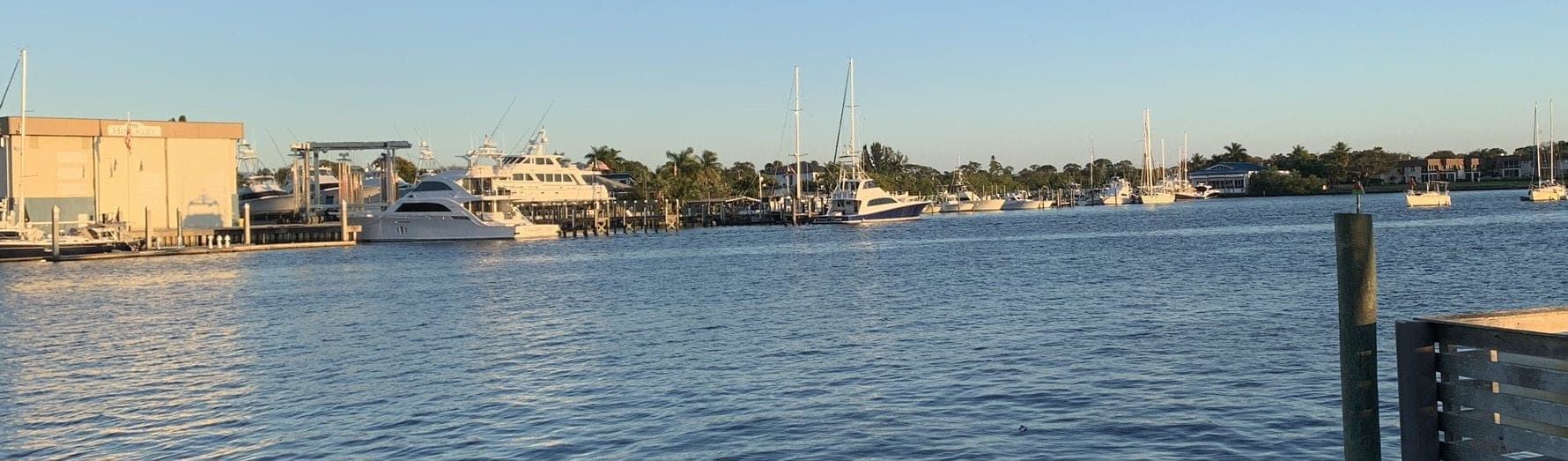
The Complete History of Port Salerno, Florida
Most Florida towns were drawn on paper before anyone lived in them. Port Salerno wasn't. It accumulated — around a protected harbor, a hand-dug inlet, a railroad siding, and a series of industries that each boomed and then vanished.
That accumulation is why the village looks the way it does today: no grid worth the name, no entry feature, housing stock spanning a century, and a working commercial dock sitting a few hundred feet from restaurant patios. This is the story of how that happened, and where the documented record is thinner than the local retellings suggest.
Before there was a village
People lived on this water for thousands of years before anyone platted a lot, and Port Salerno sits almost exactly on the boundary between two Native American peoples.
The Ais held the coast to the north, running roughly from Cape Canaveral down to the St. Lucie River. The Jeaga held the stretch to the south, between the St. Lucie and Jupiter inlets — they are the tribe Jonathan Dickinson's shipwrecked party ran into in 1696, and their village of Jobe is where the name Hobe Sound comes from. The Manatee Pocket lies close to where those two territories met, and the sources disagree about which side of the line it falls on.
What isn't disputed is the physical evidence. Both peoples lived on the lagoon's shellfish, piling up enormous middens of discarded oyster and clam shell over centuries. Martin County has roughly 49 recorded middens, mounds, and burial sites, some estimated at 3,000 to 4,000 years old. The best-known, Tuckahoe, overlooks the Indian River and once stood far higher than it does today — early settlers mined middens for road fill, which is how much of the record was lost.
Neither people survived European contact. What they left behind is why this stretch of coast is treated as archaeologically sensitive, and why certain shoreline parcels carry permitting conditions that surprise buyers.
The inlet that made everything else possible
The single most consequential event in this area's history predates the village itself.
In 1892, local settlers — led by Capt. Henry Sewall — opened the St. Lucie Inlet by hand, with picks and shovels. The first cut was about 30 feet wide and five feet deep. Within six years the ocean had done the rest of the work, widening it to roughly 1,700 feet and deepening it to six or seven. By 1922 it was around 2,600 feet across, and today Martin County describes it as one of the widest inlets in Florida at nearly half a mile.
That matters for reasons that are still felt every day. A permanent ocean connection turned the Manatee Pocket from a quiet natural bay into a usable harbor. Every commercial fishery, boatyard, marina, and charter operation that followed depended on it.
It also created a permanent maintenance obligation. The inlet received federal project status in 1913, and the county notes that dredging is typically required every two to four years to control shoaling — sand steadily filling in the channel. An inlet that wide and that shallow shoals continuously, which is why "ocean access" here has always been a question of current conditions rather than a fixed fact.
Pineapples, the railroad, and a post office
The earliest economy here was split between the water and the sandy ridge inland. Most people made a living either fishing commercially or working the pineapple farms that ran along this stretch of the Indian River in the 1890s and early 1900s.

Henry Flagler's Florida East Coast Railway reached this part of the coast in the mid-1890s, and it changed the arithmetic completely. Fish and fruit that had been limited to local consumption could now reach northern markets. The tracks still run through the middle of the village, parallel to Dixie Highway, splitting it into an east side and a west side — a division you can still read in the street pattern and the housing.
The hardest documentary marker of settlement is postal: a post office named Salerno operated from 1909 to 1959.
Pineapple didn't last. Blight, Cuban competition, and freezes ended the Indian River pineapple boom in the early twentieth century, and the water became the whole economy rather than half of it.
Where the name came from — honestly
You will read two different explanations, and they are not compatible.
The version told locally, and repeated on the community's own site and most travel writeups, is that early settlers and landowners were Italian immigrants from Salerno, Italy, a fishing city on the Amalfi coast, and they named the place after home.
The version in the encyclopedic sources is that an early visitor thought the setting resembled the Italian city, and the name stuck from there.
Both are plausible. Neither is well documented in anything we could verify, and the founding date has the same problem — 1894 is the year given by the community and by regional travel sources, while other references place the settlement's establishment in the 1920s. The 1909 post office sits awkwardly between them.
We'd rather say that plainly than pick the more charming version. If you want the documented spine: the inlet opened in 1892, the post office existed by 1909, and a photograph of boats in the Manatee Pocket at Salerno was presented to federal engineers in 1923.
Free — August 2026 Martin County Numbers
Martin County Houses Are Selling Three Weeks Faster
Houses went under contract in 56 days last month, down from 77 a year ago, and what is for sale dropped by more than a fifth. The typical house sold for $656,900. Every number is Martin County — Stuart, Palm City, Hobe Sound and Port Salerno — not Palm Beach County.
Martin County, and a bid for a deep water harbor
Martin County was created on May 30, 1925, out of parts of Palm Beach and St. Lucie counties, and named for John W. Martin, then governor of Florida. Salerno went from being a remote southern edge of one county to being part of a small new one whose seat, Stuart, was five miles up the road.
Just before that, in January 1923, the Stuart Commercial Club made a formal push to have a deep water harbor developed here, presenting photographs of the Manatee Pocket to federal government engineers at a public hearing. The images survive in the Martin County Library System's collection.
The deep water port never happened. It's worth pausing on that, because it's the great counterfactual of this place: had that bid succeeded, Port Salerno would be an industrial shipping town today rather than a village with a fishing dock. Nearly everything people value about it now exists because that proposal failed.
The shark years
The strangest and most specific chapter runs from roughly the mid-1930s to 1950.
Capt. Charles L. Mooney and his brother George established Salerno Shark Industries-Fisheries, Inc., and at its height the operation processed on the order of 25,000 sharks a year.
Almost nothing was wasted. Livers were rendered for vitamin A, which before synthesis was genuinely scarce and commercially valuable. Hides went to the Ocean Leather Corporation and came back as luggage. Carcasses were milled into meal for animal feed — a plant built around 1941 could handle roughly 200 pounds an hour. Fins were shipped to China. In 1938 a Chicago firm ordered 200,000 shark teeth for jewelry.
During the Second World War the plant was treated as essential: shark liver oil supplied vitamin A believed to support night vision in combat pilots. Robert M. French Sr. took over operations in the 1940s, and in 1944 the Borden Company bought the facility, keeping French as its chief executive.
Then chemistry ended it. Vitamin A was synthesized in 1950, the economics collapsed immediately, and Borden closed the plant that July. The building stood until June 1962, when the Port Salerno Volunteer Fire Department burned it down as a training exercise.
There's a footnote worth keeping: local fishermen noticed that decomposing shark flesh repelled other sharks. That observation was developed with government support into a wartime repellent marketed as "Shark Chaser."
Storms, and what they took
Two hurricanes did lasting damage to the working waterfront — 1928 and 1949 — destroying fish houses along the Pocket, some of them blown down and carried out to sea.
This is a recurring pattern rather than a pair of incidents. The village's oldest structures are the ones that happened to survive, which is part of why the built record here is so patchy and why so little of the pre-war waterfront remains standing.
From Salerno to Port Salerno
The name change is the messiest fact in the record.
The postal evidence is clean enough: the Salerno post office closed in 1959 and a Port Salerno post office opened the same year. Several sources date the formal change to 1960, explaining it as a way to avoid confusion with the Italian city. Others claim the "Port" was added as early as 1924 or 1925.
The 1959–60 window has the better documentary support. Treat the 1920s date as unconfirmed.
Growth, and a different kind of money
The village that had run on fish began to run on something else.
Census figures show the pace: 4,511 residents in 1980, 7,786 in 1990, and 10,141 by 2000. It has been broadly flat since — 10,091 in 2010 and 10,401 in 2020 — with a median age of 52 at the last count.
From the 1970s onward, developers recognized what the water was worth for reasons unrelated to catching anything, and golf and boating communities were built in the surrounding area. Recreational boating, marine trades, and sportfishing charters gradually replaced commercial fishing as the harbor's economic engine — a shift that was already well underway before the event that made it permanent.
The net ban
In November 1994, Florida voters approved a constitutional amendment banning entangling nets — gill and trammel nets — in state waters, by roughly 72 percent. It took effect in July 1995.
For a village built on commercial fishing, this was the defining modern event. Before the ban, 253 full-time commercial fishermen worked out of Port Salerno. In the years after, that number fell to around 40.
Whatever you think of the amendment — and it is credited with substantial recoveries in redfish, snook, and seatrout — the local economic effect is not in dispute. An industry that had defined the place for a century became a remnant of itself within a few years.
Organizing to keep the working waterfront
What happened next is the part most visitors never hear, and it's the reason there is still a fishing dock here at all.
Rather than let the waterfront convert entirely to restaurants and condominiums, the fishermen and the county organized.
- The community received a Waterfronts Florida designation in 2001, a state program supporting working-waterfront revitalization.
- A Community Redevelopment Area was established for Port Salerno, with a plan adopted around 2000–2001 and revised in 2009. Its stated goals included public waterfront access, preserving commercial fishing, economic revitalization, and hazard mitigation.
- The county found that 15 commercial fishing docks were sitting on county right-of-way. Instead of clearing them, Martin County obtained a state submerged land lease and leased the property to a nonprofit Port Salerno Commercial Fishing Dock Authority for $8,055 a year — matching the state's own fee — on renewable ten-year terms.
- The Manatee Pocket Walk was built in phases, with mooring slips and interpretive signage in 2003 and an eight-foot boardwalk between the docks and the loading station in 2006.
- A Stan Mayfield Working Waterfronts grant in 2011 funded the purchase of nearly two acres for the Historic Salerno Fishing Village.
The main street was redesigned to be more walkable, and a civic center and fire station were built. The commercial fishing dock that remains is the last one in Martin County.
What the history explains
If you're looking at property here, the past is not decoration. It shows up in the due diligence.
The housing stock has no single era because the village grew in bursts tied to whatever industry was working at the time. Lot lines and street patterns predate modern planning, which is why a renovated cottage, a 1970s block home, and a vacant lot can share one block — and it's why the areas of the village differ so much.
The working waterfront is protected by design, not by accident. The dock, the boatyards, and the marine trades are there because of deliberate public decisions in the 2000s. Early-morning commercial activity near the Pocket is a permanent feature, not a phase — which is part of how this village compares with Stuart today.
Ocean access has always been conditional. An inlet that has needed maintenance since 1913 still needs it.
Infrastructure is uneven because it was retrofitted onto a settlement that predated it. The county's own redevelopment priorities have included extending central sewer and water to areas that still lack them — which is why utility service is an address-by-address question here rather than a village-wide one.
Age of construction also drives what a property costs to hold. Older homes are harder to insure, and what an older waterfront property costs to own can differ sharply between two houses at the same asking price.
Confirm anything property-specific — flood zone, elevation, utilities, permit history, archaeological review — with Martin County and the appropriate licensed professionals before you rely on it.
A short timeline
| Year | Event |
|---|---|
| 3,000–4,000 years ago | Ais and Jeaga peoples; shell middens along the lagoon |
| 1892 | St. Lucie Inlet opened by hand, led by Capt. Henry Sewall |
| Mid-1890s | Florida East Coast Railway reaches the area; pineapple era |
| 1909 | Salerno post office established |
| 1913 | Inlet gains federal project status |
| 1923 | Stuart Commercial Club's deep water harbor bid |
| 1925 | Martin County created, May 30 |
| 1928, 1949 | Hurricanes destroy fish houses on the Pocket |
| Mid-1930s–1950 | Shark industry; ~25,000 sharks a year |
| 1944 | Borden Company buys the shark plant |
| 1950 | Vitamin A synthesized; plant closes in July |
| 1959–60 | Salerno becomes Port Salerno |
| 1994–95 | Florida net ban; commercial fleet collapses |
| 2001 | Waterfronts Florida designation |
| 2003, 2006 | Manatee Pocket Walk phases |
| 2011 | Stan Mayfield grant funds Historic Salerno Fishing Village |
Thinking about buying here?
If you're looking at a specific property in Port Salerno, its history is part of the diligence. Age of construction drives insurability, permit history determines what you inherit, and proximity to the working waterfront is a permanent condition rather than a passing one.
Send us the address. We'll tell you honestly what era the house is from, what that usually means for insurance and inspections, what the location is like at six in the morning as well as at six at night, and anything else we'd want to know if we were buying it ourselves. No charge, no obligation.
Community Guide
Neighborhoods, schools, prices, and lifestyle — all in one place.
Stuart Market Trends
Live MLS data for Stuart — the closest market with full single-family coverage. Port Salerno is not reported separately.
Homes for Sale in Port Salerno
Single-family homes $500k+, updated daily.
Free — August 2026 Martin County Numbers
Martin County Houses Are Selling Three Weeks Faster
Houses went under contract in 56 days last month, down from 77 a year ago, and what is for sale dropped by more than a fifth. The typical house sold for $656,900. Every number is Martin County — Stuart, Palm City, Hobe Sound and Port Salerno — not Palm Beach County.
Free instant PDF · No obligation
Frequently Asked Questions
When was Port Salerno founded?
There isn't a clean answer. The community's own site and most regional sources say 1894; other references place the settlement's establishment in the 1920s. The firmest documentary markers are the St. Lucie Inlet's opening in 1892 and a Salerno post office operating from 1909.
Why is it called Salerno?
Two accounts circulate. One holds that early settlers and landowners were Italian immigrants from Salerno, Italy, and named the place after home. The other says an early visitor thought the setting resembled the Italian city. Neither is firmly documented.
When did Salerno become Port Salerno?
Around 1959–60. The Salerno post office closed in 1959 and a Port Salerno post office opened the same year, and several sources date the formal change to 1960. Claims that the "Port" was added in the 1920s are unconfirmed.
Was Port Salerno really a shark fishing town?
Yes, and it was a substantial industry. From the mid-1930s to 1950 the operation processed roughly 25,000 sharks a year, mainly for vitamin A extracted from the livers, with hides going to leather and carcasses to animal feed. The Borden Company bought the plant in 1944. When vitamin A was synthesized in 1950 the market disappeared and the plant closed that July.
What happened to Port Salerno's commercial fishing industry?
Florida voters banned entangling nets in November 1994, effective July 1995. Port Salerno had 253 full-time commercial fishermen before the ban; roughly 40 remained afterward. The marine trades, charter fishing, and recreational boating largely took its place.
Is there still a working fishing dock in Port Salerno?
Yes — the last one in Martin County. It survives because of deliberate public action in the 2000s, including a state submerged land lease that the county passes through to a nonprofit dock authority, and a 2011 state grant that funded land for the Historic Salerno Fishing Village.
Why does Port Salerno look so different from block to block?
Because it was never master-planned. The village accumulated around the harbor across a century of boom-and-bust industries, so lot lines and street patterns predate modern planning and the housing stock spans many eras. Two houses on the same street can be sixty years apart.
Keep Reading
This article is provided by DO Homes Group at Premier Brokers International for informational purposes only and does not constitute legal, financial, tax, or investment advice. Market statistics, pricing, availability, HOA fees, and community details change frequently and may have changed since publication. School assignments, boundaries, and ratings may change — verify all school information directly with the appropriate school district, and consult official public safety resources for any crime data relevant to your search. Verify all details independently and consult the appropriate licensed professionals before making any real estate decision. DO Homes Group is committed to Equal Housing Opportunity and does not discriminate on the basis of race, color, religion, sex, handicap, familial status, or national origin.