

Condo Due Diligence
Downtown Boca Raton Parking: What Condo Buyers Should Know
Public parking policy and the parking you actually buy are two different things.
By John OliverUpdated
Representative image of a parking structure, not a downtown Boca Raton facility. Photo by Claudio Schwarz / Unsplash.
Before you offer: confirm these parking terms in writing
Parking terms vary between buildings on the same street, and a listing rarely spells them out. Get these answers from the association's governing documents — not from a listing sheet or a showing agent — before you write an offer.
- How many spaces convey with the unitStated in the deed or the purchase contract, not implied by the listing.
- Whether spaces are deeded or assignedA deeded space is property you own; an assignment can, in some buildings, be changed by the association.
- The exact space numbers and where they areLevel, column, distance to the elevator, and whether the space is tandem, compact or oversized.
- Guest parking and overnight visitor rulesWhere guests park, who authorizes it, and what happens overnight. On-street metered spaces downtown carry a four-hour maximum with enforcement available 24 hours, and the free City lots post overnight prohibitions — so a guest cannot simply leave a car on the street.
- Waitlist, rental or purchase options for a second spaceWhether one is available at all, what it costs, and whether it conveys on resale.
- EV charging: availability, cost and approvalWho owns the charger, who pays for the electricity, and what the association requires before you install one.
- Vehicle, commercial-vehicle and valet restrictionsSize and height limits, pickup trucks, work vehicles, motorcycles, and whether valet is mandatory.
- Whether the building relies on a city or CRA license agreementSome downtown buildings license public spaces for valet stands or loading zones. Ask whether one exists, when it expires, and what the building does if it is not renewed.
- Current HOA parking rules and any recent changesRead the rules as they stand today, plus recent board minutes — parking rules change more often than declarations do.
Posted signs, the association’s governing documents and any recorded parking assignment control for a specific space. Municipal policy sets the backdrop; it does not convey parking with a unit.
Policy snapshot
Last verified
- What the CRA reviewed
- On July 27, 2026 the Community Redevelopment Agency received a downtown parking overview and a follow-up on parking license agreement requests: current operations, revenue and enforcement figures, the eight active license agreements, and the pilot programs.
- What was decided
- Nothing. It was a presentation with no motion, vote or resolution. Staff recommended continuing to renew existing license agreements while limiting new ones to lower-utilization areas, but the CRA gave no direction on the record.
- Current rates
- Downtown City-owned metered spaces are $2.00 per hour under the user fee schedule effective October 1, 2025. All on-street spaces inside the CRA boundary are metered, with a four-hour maximum and enforcement available 24 hours a day.
- The 29-minute pilot
- Adopted by CRA consensus on November 18, 2024 as a three-month trial on NE 1st Avenue, and later extended to Boca Raton Road. It is still running, and it is still a pilot — no resolution has made it permanent, and it does not appear in the adopted fee schedule.
- How to pay
- The City uses ParkMobile on downtown meters, where the space number is the zone number. Some private garages, including The Mark at Cityscape and Royal Palm Place, use a different system.
Not supported by any current official source
- Different parking rules east versus west of Federal Highway. The adopted fee schedule sets one downtown rate, and the staff phrase about areas "mainly west of Federal Highway" applies only to where new license agreements might be granted.
- Any downtown resident or condo parking permit program. None appears on the City parking pages or in the fee schedule.
- New public parking supply downtown. No garage is in an adopted plan, and the Downtown Campus redevelopment failed at referendum in March 2026.
- A published enforcement-hours window. The only official statement is that enforcement is available 24 hours a day.
- Any City policy on condo guest parking or buildings using City garages for overflow — which is exactly why a building’s own documents are the answer.
Two parking systems affect a downtown condo purchase
Building parking — what you actually buy
- Spaces that convey with the unit, by deed or by assignment, in the numbers and locations the documents specify
- Guest parking, EV charging and vehicle restrictions, set by the association's rules
- Any off-site or licensed spaces the building depends on, which under the downtown ordinance must sit within 600 feet and be secured by a recorded instrument
- This is the part that conveys, and the only part a purchase contract can guarantee
Public parking — what the City controls
- Metered on-street spaces, City lots and the Mizner Park garages, with rates set in the adopted fee schedule
- Time limits and enforcement: a four-hour maximum, with enforcement available 24 hours a day
- Pilot programs such as the 29-minute free rate, which can change at any meeting
- This affects convenience, guests and the health of downtown retail — it does not add parking to your unit
What the CRA actually reviewed
The Community Redevelopment Agency — Boca's redevelopment board, legally distinct from City Council even though the same elected officials sit on both — took a downtown parking overview on July 27, 2026, along with a follow-up on requests for parking license agreements.
Those agreements are the mechanism by which a private building licenses public spaces: a valet stand in the right-of-way, a loading zone, a few spaces in a bank lot. Eight are currently active, all of them renewals of existing licenses, with expirations running from 2026 to 2031. Several new requests were on the table.
What did not happen is a decision. There was no motion, no vote and no resolution. Staff recommended continuing to renew existing agreements while limiting new ones to lower-utilization areas, and the board gave no direction on the record. That matters for how you read any summary of this meeting — including the earlier version of this article, which described the direction as settled.
The 29-minute free parking pilot, explained
Twenty-nine minutes is a deliberate number: long enough for a quick errand, short enough that nobody parks all day for free. It is a standard turnover tool for the spaces that serve shops and restaurants.
Three things about it are worth knowing before you factor it into daily life:
- It is not downtown-wide. It started on NE 1st Avenue and later expanded to Boca Raton Road. Everywhere else, the meter is the meter.
- It is still a pilot. The CRA approved it by consensus in November 2024 as a three-month trial. It has been running ever since without a resolution making it permanent, and it does not appear in the adopted fee schedule.
- It is lightly used. Staff reported roughly 8% of transactions taking the free rate on 1st Avenue, and about 15% on Boca Raton Road.
Treat it as a convenience that currently exists, not as a feature of the neighborhood you are buying into.
What the City controls, and what it doesn't
Inside the CRA boundary, every on-street space is metered, at $2.00 an hour under the fee schedule that took effect in October 2025. There is a four-hour maximum, and the City's own presentation says enforcement is available 24 hours a day. Downtown meters are paid through ParkMobile, where the space number doubles as the zone number.
Some parking downtown is free: the City Hall and library lots, and the Mizner Park garages. The library lots post overnight prohibitions.
None of that changes what conveys with a condo. The City sets the price and the rules for public spaces. Your deed, your association's documents and any recorded parking assignment decide what you own.
Why this matters more downtown than in the suburbs
In a downtown purchase, parking is part of what you are buying rather than a detail attached to it. How many spaces convey, whether they are deeded or assigned, where they sit and what happens when you have guests all affect daily life and resale.
Public policy sits underneath that. Rates, limits and enforcement shape how easy it is for a visitor to stop by and how the surrounding retail fares over time. It is worth understanding — and it is not a substitute for reading the documents.
Guests are where this gets real
A four-hour maximum with 24-hour enforcement means a guest cannot legally leave a car on a downtown street overnight, and the free City lots post overnight restrictions of their own. So "my friends can just park on the street" is not a plan.
The City publishes no policy on condo guest parking, and none on buildings using public garages for overflow. What exists instead is in the buildings' own approvals: the downtown ordinance allows off-site parking within 600 feet, subject to CRA Board approval and a recorded instrument keeping those spaces available. If a building depends on off-site or licensed spaces, that arrangement lives in its development approval and its governing documents — which is where to look.
Comparing downtowns
Delray Beach and West Palm Beach run their own programs, with their own rates, limits and payment systems, and each city posts its own rules. The useful generalization is narrower than it looks: parking terms vary more between buildings in one downtown than they do between cities. Compare the specific building, not the city.
What this may mean for condo buyers
Downtown Boca's public parking is being actively managed — metered, monitored, and adjusted through pilots rather than left alone. For a buyer, the practical implications are modest and mostly about guests and convenience.
The part that deserves your attention is the part a city page cannot answer: what conveys with the unit, what the association's rules say, and whether the building leans on an arrangement that has an expiration date on it. The checklist above is the version of this article worth keeping.
How the current policy got here
Only actions that appear in adopted minutes, an adopted fee schedule or an official City page.
29-minute free parking starts as a three-month trial
The CRA reached consensus to try a 29-minute free rate on NE 1st Avenue — by consensus in a director’s report, not by resolution.
Current parking rates take effect
The adopted user fee schedule sets downtown metered parking at $2.00 per hour, along with citation amounts.
Downtown Campus redevelopment fails at referendum
The City states the project will not move forward as proposed — which is why no adopted plan currently adds downtown public parking.
The 29-minute rate expands to Boca Raton Road
Staff reported roughly 8% of transactions using the free rate on 1st Avenue and about 15% on Boca Raton Road.
CRA parking presentation, July 2026 (PDF)(opens in a new tab)
CRA parking overview and license-agreement follow-up
A presentation covering operations, the eight active license agreements and pending requests. No vote was taken.
The 29-minute pilot has run well past its three-month trial without a resolution extending or ending it, so it can change at any CRA meeting. We update this page when an official record changes.
Check the current rules yourself
Parking rates, limits and pilots are set by the City and the CRA, and they change by meeting rather than by season. These are the sources that actually govern.
- City of Boca Raton: parking(opens in a new tab)
- Adopted user fee schedule (current rates and citations)(opens in a new tab)
- ParkMobile: how downtown meters are paid(opens in a new tab)
- Downtown Boca parking map(opens in a new tab)
- CRA and City agendas, minutes and meeting video(opens in a new tab)
There is no official City FAQ on downtown parking, and nothing official about condo guest parking — which is why the building documents matter more than any city page.
Community Guide
Neighborhoods, schools, prices, and lifestyle — all in one place.
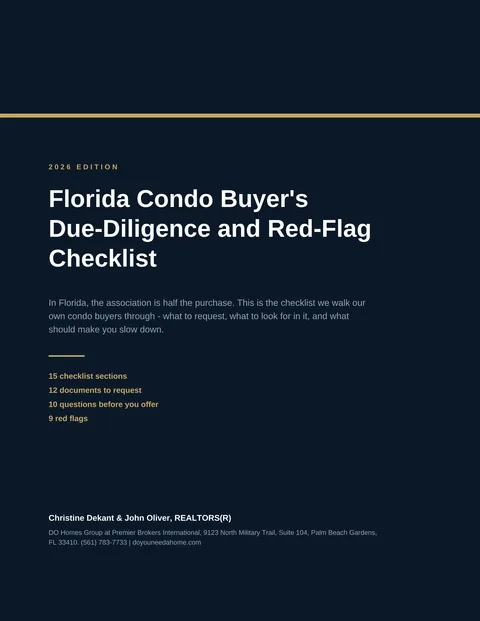
Free Condo Buyer’s Checklist
Check the Building Before You Buy the Unit
15 sections of documents to request and questions to ask — reserves, assessments, milestone inspections, insurance, financing, rental rules — plus 9 red flags worth walking away from.
Boca Raton Market Trends
Live data from the local MLS.
Homes for Sale in Boca Raton
Single-family homes $500k+, updated daily.
Frequently Asked Questions
How much is parking in downtown Boca Raton?
Downtown City-owned metered spaces are $2.00 per hour under the user fee schedule that took effect October 1, 2025. All on-street spaces inside the CRA boundary are metered, with a four-hour maximum, and the City's own July 2026 presentation says enforcement is available 24 hours a day. The City Hall and library lots and the Mizner Park garages are listed as free, with overnight restrictions posted at the library lots. Rates change by resolution, so check the current fee schedule before relying on any figure.
Is the 29-minute free parking still available in downtown Boca Raton?
Yes, as a pilot rather than a permanent program. The CRA approved it by consensus on November 18, 2024 as a three-month trial on NE 1st Avenue and it later expanded to Boca Raton Road. It has continued past that trial period without a resolution making it permanent, and it does not appear in the adopted fee schedule. It is also not downtown-wide — everywhere else, standard meter rates apply.
Are parking rules different east and west of Federal Highway?
Not in any current official source. The adopted fee schedule sets a single downtown rate, and the downtown ordinance contains no east/west parking provision. The phrase comes from a staff recommendation about where the CRA might grant new parking license agreements to private buildings — which is a different question from what a driver pays or how long they can stay.
What parking questions should I ask before buying a downtown Boca condo?
How many spaces convey and whether they are deeded or assigned; the exact space numbers and locations; guest and overnight rules; whether a second space can be rented or bought; EV charging availability, cost and approval; vehicle and valet restrictions; whether the building relies on a city or CRA license agreement; and the association's current parking rules plus any recent changes. Get the answers from the governing documents in writing, not from a listing.
Where can guests park at a downtown Boca Raton condo?
That depends entirely on the building, which is why it belongs on your due-diligence list. On-street metered spaces carry a four-hour maximum with enforcement available 24 hours a day, and the free City lots post overnight prohibitions, so a guest cannot simply leave a car downtown overnight. The City publishes no condo guest-parking policy. If a building uses off-site spaces, the downtown ordinance requires them within 600 feet, with CRA Board approval and a recorded instrument.
Is Boca Raton adding more public parking downtown?
Not in any adopted plan. The Downtown Campus redevelopment failed at referendum in March 2026, and the current downtown plan amendments do not include a parking project. The City is managing existing supply instead, through pilots such as the 29-minute rate and space-occupancy monitoring. Do not assume new public parking will appear to solve a tight situation at a specific building.
Keep Reading
This article is provided by DO Homes Group at Premier Brokers International for informational purposes only and does not constitute legal, financial, tax, or investment advice. Market statistics, pricing, availability, HOA fees, and community details change frequently and may have changed since publication. School assignments, boundaries, and ratings may change — verify all school information directly with the appropriate school district, and consult official public safety resources for any crime data relevant to your search. Verify all details independently and consult the appropriate licensed professionals before making any real estate decision. DO Homes Group is committed to Equal Housing Opportunity and does not discriminate on the basis of race, color, religion, sex, handicap, familial status, or national origin.