
Juno Beach · Ownership Costs
Cost of Living in Juno Beach, Florida
Property taxes, insurance, condo obligations, maintenance and household spending: how to build a budget for a specific Juno Beach address, and what to verify before you make an offer.
By John OliverUpdated

There's no single Juno Beach cost-of-living number worth trusting. What you'll actually spend depends mostly on the property and building you choose: a condominium in an older oceanfront building, a newer one, and a single-family home a few streets away can carry very different costs at a similar price.
The purchase price is only the first line. Property taxes, insurance, association obligations, maintenance, utilities and your own household spending each need their own review, and most of them can be checked for a specific address before you make an offer. Here's how to build that budget.
In this guide
Your budget map
| Cost category | What changes it | What to verify before an offer |
|---|---|---|
| Purchase price and financing | Property type, condition, location, loan terms | Comparable active listings and recent sales; your lender's terms |
| Property taxes | Assessed value, exemptions, millage, non-ad valorem assessments | The Property Appraiser's tax estimate for the exact address |
| Homeowners, wind and flood coverage | Building, roof, mitigation, flood exposure, insurer, policy | Binding quotes, deductibles, exclusions and lender requirements |
| Condo or HOA costs | What the association covers, its budget, reserves and insurance | Budget, financials, reserves, inspections, minutes and assessments |
| Maintenance and building condition | Age, systems, roof, exposure to salt and sun | Inspection findings and maintenance or permit history |
| Utilities and services | The home's systems, occupancy, usage, what the association includes | Which utilities and services are included, and recent bills if available |
| Lifestyle and travel | Your household's habits | Your own routes and routines |
Housing: compare the right properties
Juno Beach is small and coastal, so the homes that fit a particular buyer at any given time can be a short list. That doesn't mean supply is fixed. The Town's zoning ranges from single-family districts to multifamily and residential-high districts, and the Town says its residential-high district allows buildings of up to 12 stories and 130 feet (Town of Juno Beach). Its history notes that The Tower, built in 1972, was the town's first 12-story condominium.
Rather than compare price per square foot across towns, compare complete carrying costs across the homes you'd actually buy. Line them up by:
- Property type: condominium, townhome, single-family or other.
- Building age and condition, including the roof and major systems.
- Proximity to the ocean or other water, and the exposure that comes with it.
- Included services, such as insurance, water, cable or exterior maintenance.
- Association structure: one association, several, or none.
- Maintenance exposure: what you'd be responsible for yourself.
- Exact location and day-to-day access, including parking and beach access from that address.
Our guide to Juno Beach neighborhoods and areas explains how the in-town areas differ.
Property taxes: calculate, don't inherit the listing number
The tax figure on a listing usually reflects the current owner's bill, based on their assessed value and exemptions. It may not represent what you'll pay.
In plain English, a Palm Beach County tax bill works like this (Property Appraiser):
- Assessed value. The Property Appraiser values property as of January 1 (residential appraisal). Assessed value is that value after any assessment limitation; the Property Appraiser says increases are capped at 3% a year for homesteaded properties and 10% for non-homesteaded properties.
- Exemptions reduce assessed value to taxable value.
- Millage is the tax rate: dollars per $1,000 of taxable value, set by the taxing authorities.
- Non-ad valorem assessments are charges for services that aren't based on the property's value.
The practical step: run the Property Appraiser's property tax calculator for the exact address. It asks for your purchase price and whether you intend to homestead the property, and gives you an estimate to budget against instead of the seller's bill.
Homestead and portability
If the home will be your permanent residence, the homestead exemption may reduce its taxable value and bring the Save Our Homes cap on annual assessment increases. In Palm Beach County, applicants must be eligible as of January 1 and file by March 1 of the year the benefit applies; the Property Appraiser describes a separate late-file process. Eligibility depends on your circumstances.
If you're moving from a Florida homestead, portability may let you transfer all or part of your accumulated Save Our Homes benefit, up to $500,000, to a new homestead, subject to timing and eligibility rules. It needs its own application.
Florida doesn't impose a personal income tax, according to the Florida Department of Revenue. None of this is tax advice: your overall tax situation needs a qualified tax professional.
Insurance and flood: get address-level answers
Coverage, pricing, deductibles, availability and lender requirements vary with the property, the insurer, the policy, roof and construction features, flood exposure, claims history and your own circumstances. Standard homeowners policies generally don't cover flood damage; flood coverage is usually a separate policy, though some insurers offer it as an endorsement (Florida Department of Financial Services).
During due diligence:
- Get property-specific quotes for homeowners, wind and flood coverage.
- Ask about exclusions, deductibles, wind or hurricane provisions and flood options.
- Confirm your lender's requirements in writing.
- Review the roof's age, permits and any wind-mitigation documentation, and ask whether documented features would affect your quote.
- Ask for claims and maintenance information where it's available.
- **Check the Town's flood hazard information,** which includes flood map determinations.
- Talk to licensed insurance professionals before you commit.
Condo and HOA costs: inspect the building, not just the dues
Monthly dues tell you what the association charges today, not what the building needs. Two buildings with similar dues can be in very different financial and physical shape. As applicable, review:
- The current budget and financial statements.
- Reserve information, and structural integrity reserve materials where they're required.
- Inspection reports and planned or recent repair projects.
- The master insurance summary, its deductibles, and what the unit owner must insure.
- The governing documents.
- Recent meeting minutes.
- Any pending, recent or disclosed special assessments.
- Building-specific maintenance, litigation and financing considerations.
Florida law sets reserve and structural integrity reserve study requirements for condominium associations, and which ones apply depends on the building (section 718.112, Florida Statutes). Review the documents with qualified advisers. Our Florida condo buyer's due-diligence checklist lists what to request.
Ongoing household costs

Some costs belong to the address; others belong to your household.
- Utilities and services depend on the home's systems, occupancy and usage, and on what an association already includes.
- Maintenance. Near the water, salt air and sun can be hard on exterior finishes, screens, fixtures and outdoor equipment. Ask your inspector what they see, review the maintenance history, and plan a maintenance reserve.
- Dining, commuting, recreation and travel are household choices, not fixed Juno Beach costs.
Build a realistic monthly and annual budget
Address-specific
- Principal and interest
- Property tax estimate for the exact address
- Insurance quotes, and the deductibles you'd carry
- HOA or condo dues
- Known assessments, and any reserve or repair exposure
- Utilities an association doesn't include
- A maintenance reserve
Household-specific
- Food and dining
- Transportation
- Travel
- Services
- Recreation and discretionary spending
Then compare the full carrying cost across your actual candidate homes, not just the list price or the price per square foot.
The bottom line
Juno Beach can carry meaningful ownership-cost tradeoffs, but the right answer comes from the individual property and building, your financing, the insurance you can get, your tax eligibility and how you live. Leave with a verification plan, not a general verdict. Our look at the pros and cons of living in Juno Beach covers the tradeoffs beyond cost.
Community Guide
Neighborhoods, schools, prices, and lifestyle — all in one place.
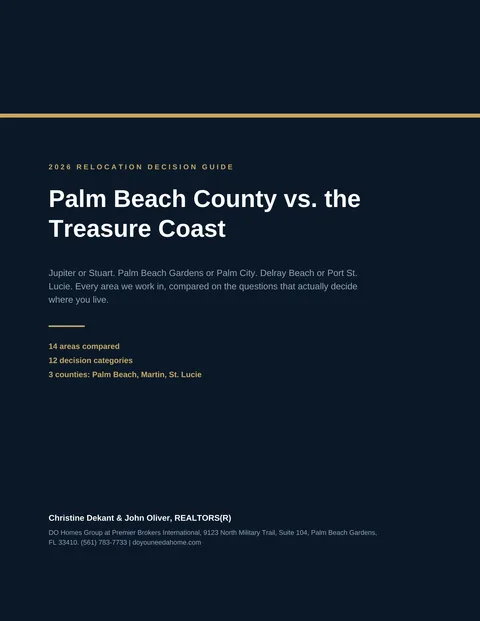
Free Relocation Decision Guide
Palm Beach County or the Treasure Coast?
A side-by-side comparison of 14 areas we actually work in — from Boca Raton to Port St. Lucie — across 12 things that decide where you should live.
Juno Beach Market Trends
Live MLS list-price data only: asking prices, not closed sales.
Homes for Sale in Juno Beach
Single-family homes $500k+, updated daily.
Frequently Asked Questions
Is Juno Beach expensive to live in?
There's no single citywide number worth relying on. Costs depend mostly on the property and building: the price, property taxes, insurance, association obligations, maintenance and utilities, plus your own household spending. Compare the full carrying cost of the specific homes you're considering.
How do I estimate property taxes for a Juno Beach home?
Run the Palm Beach County Property Appraiser's property tax calculator for the exact address. It asks for your purchase price and whether you intend to homestead the property. Tax bills depend on assessed value, exemptions, millage rates and non-ad valorem assessments.
Will my property taxes match the listing?
Not necessarily. A listing's tax figure usually reflects the current owner's assessed value and exemptions, which may not represent your future bill. Use the Property Appraiser's calculator instead of the seller's bill.
Do I need flood insurance in Juno Beach?
It depends on the property and your circumstances. Standard homeowners policies generally don't cover flood damage, and flood coverage is usually a separate policy or, with some insurers, an endorsement. Get property-specific quotes and confirm your lender's requirements during due diligence.
What should I review before buying a condo in Juno Beach?
As applicable: the current budget and financial statements, reserve information and any required structural integrity reserve materials, inspection reports and repair projects, the master insurance summary and deductibles, the governing documents, meeting minutes, and any pending, recent or disclosed special assessments. Review them with qualified advisers.
When do I file for homestead in Palm Beach County?
Applicants must be eligible as of January 1 and file by March 1 of the year the benefit applies, according to the Property Appraiser, which also describes a late-file process. Eligibility depends on your circumstances. Florida doesn't impose a personal income tax, but your overall tax situation needs a qualified tax professional.
Keep Reading
This article is provided by DO Homes Group at Premier Brokers International for informational purposes only and does not constitute legal, financial, tax, or investment advice. Market statistics, pricing, availability, HOA fees, and community details change frequently and may have changed since publication. School assignments, boundaries, and ratings may change — verify all school information directly with the appropriate school district, and consult official public safety resources for any crime data relevant to your search. Verify all details independently and consult the appropriate licensed professionals before making any real estate decision. DO Homes Group is committed to Equal Housing Opportunity and does not discriminate on the basis of race, color, religion, sex, handicap, familial status, or national origin.